Supermarket Slip and Fall in New Jersey: Who Is Liable?
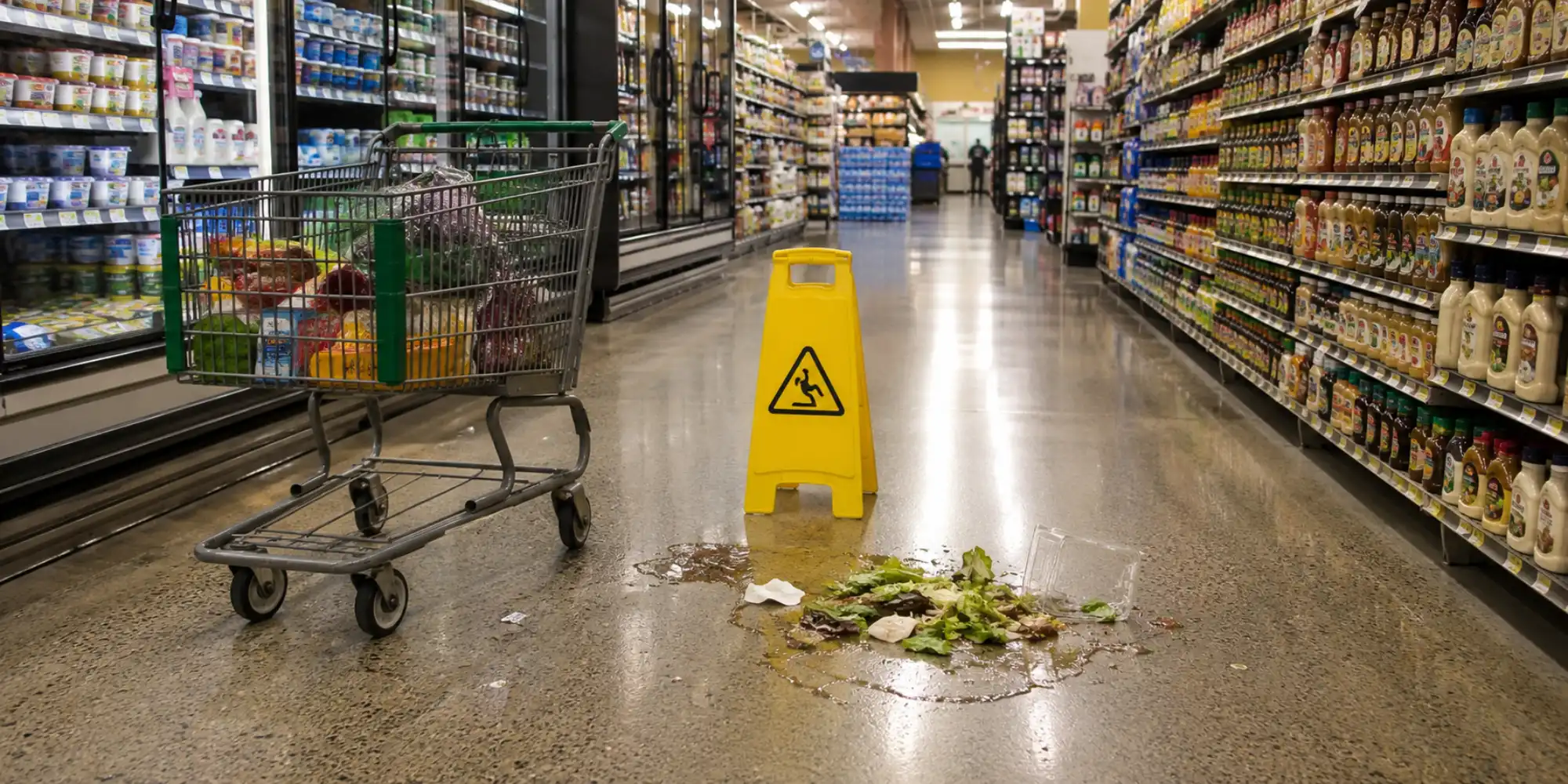
Breaks down NJ's actual/constructive notice standard and the mode-of-operation rule from Wollerman and Nisivoccia, which shifts the burden to the store for self-service hazards. Covers comparative negligence and the 2-year deadline.
A fall in a supermarket can happen in the time it takes to reach for a bag of grapes, but proving who is responsible for it depends on rules that most people have never heard of. New Jersey generally requires an injured shopper to show the store knew, or should have known, about a hazard, but a special rule developed by the New Jersey Supreme Court can shift that burden when a store's own self-service setup is what created the risk in the first place. Knowing which rule applies to your fall changes how the entire case gets built.
What Duty Does a Supermarket Owe Its Customers?
Under New Jersey law, a business owes its customers, legally called invitees, a duty of reasonable care to keep the premises safe for the purposes of their visit. This generally means the store must inspect for hazards, address dangerous conditions within a reasonable time and warn customers about risks that cannot be immediately fixed. This is a general negligence standard, and in most cases it requires the injured customer to show the store had notice of the specific hazard that caused the fall.
What Is Actual and Constructive Notice?
Actual notice means an employee or manager knew about the hazard before the fall, for example if a customer reported a spill and staff had time to respond before you slipped on it. Constructive notice means the condition existed long enough that a reasonably careful store, through routine inspection, should have discovered and addressed it. A spill that formed moments before your fall is difficult to hold a store liable for without some other basis, while a puddle that had clearly been there long enough to spread, dry at the edges or collect footprints is more likely to support constructive notice.
What Is the Mode of Operation Rule?
New Jersey recognizes an important exception to the notice requirement called the mode of operation rule. When a store's self-service business model itself creates a foreseeable risk of a hazard, an injured customer does not have to prove the store knew about that specific spill or hazard. Instead, the burden shifts to the store to show it took reasonable steps to guard against the risk its own operations created.
This rule traces back to Wollerman v. Grand Union Stores, decided by the New Jersey Supreme Court in 1966, where a customer slipped on a string bean in a self-service produce aisle. The Court later extended the rule in Nisivoccia v. Glass Gardens in 2003, involving a shopper who slipped on loose grapes sold in open, vented bags near a checkout lane, and again in Prioleau v. Kentucky Fried Chicken in 2015, applying the same logic to self-service condiment and drink stations.
Attorney insight: The mode of operation rule can be the difference between a case that survives and one that gets dismissed for lack of notice. Whether it applies often comes down to exactly how the product involved was displayed or packaged, which is why I look closely at the specific area and setup where a fall happened.
Does the Mode of Operation Rule Apply to Every Fall?
No. New Jersey courts apply a three part test before the mode of operation rule shifts the burden to the store: the business must operate on a self-service basis, the location of the fall must bear a relationship to that self-service component and there must be a genuine connection between the hazard and the store's chosen method of operation. Courts have declined to apply the rule to hazards like melted condensation from an ice cream freezer or a random object on the floor unrelated to any self-service display, since those situations do not show that the store's operational choices, rather than simple bad luck, created the risk.
How Does Shared Fault Affect Your Claim?
You can still recover damages even if you share some of the blame, but your compensation is reduced by your percentage of fault, and you are barred from recovering entirely if you are found more than half responsible. New Jersey follows a modified comparative negligence rule under N.J.S.A. 2A:15-5.1: if your damages total 100,000 dollars and you are found 20 percent at fault, your recovery drops to 80,000 dollars. Stores frequently argue that a customer was distracted or ignored a warning sign, which makes documenting the scene as it appeared right after the fall especially important.
What Evidence Matters Most in These Cases?
Surveillance footage is often the single most valuable piece of evidence in a supermarket fall, since it can show how long a hazard was present and whether an employee walked past it beforehand. Reporting the fall to a manager and requesting a written incident report, photographing the hazard before anyone cleans it up and collecting names of any witnesses all strengthen a case considerably. Supermarkets frequently overwrite surveillance footage on a set schedule, sometimes within days or weeks, so requesting preservation of that footage as early as possible protects evidence that can otherwise disappear.
How Long Do You Have to File a Claim?
In most cases you have two years from the date of the fall to file a lawsuit under N.J.S.A. 2A:14-2. If the property is owned or operated by a government entity, such as a supermarket located inside a public transportation hub or on municipal property, a much shorter 90 day notice of claim requirement can apply instead under the New Jersey Tort Claims Act.
How Can a Lawyer Help After a Supermarket Fall?
I move quickly to request surveillance footage before it can be overwritten, obtain the store's incident report and identify whether the mode of operation rule applies based on exactly how the hazardous product was displayed or packaged. From there I gather medical records and witness statements and negotiate directly with the store's insurer, all on a no win no fee basis.
The Bottom Line
A supermarket slip and fall claim in New Jersey often comes down to a single question: did the store have notice of the hazard, or did its own self-service setup create the risk in the first place. Getting surveillance footage and other evidence secured quickly, before it disappears, is often what determines whether that question can even be answered.
If you were hurt in a fall at a supermarket anywhere in Passaic, Bergen, Essex or Morris County, I would be glad to review what happened and give you a straight answer on your options


Answers, before you even call.
Have a question we didn't cover? Contact us anytime. Every consultation is free, confidential, and no-strings.

Hurt in New Jersey? Let's Talk.
James Vasquez gives injured people across New Jersey a free, no obligation case review. Tell us what happened and we'll walk you through your options and what your claim may be worth.
.png)
Reach us whatever way works for you.
Need to talk to someone right now?

Areas we serve



.jpg)