Slip and Fall on Ice in New Jersey: Liability & Compensation
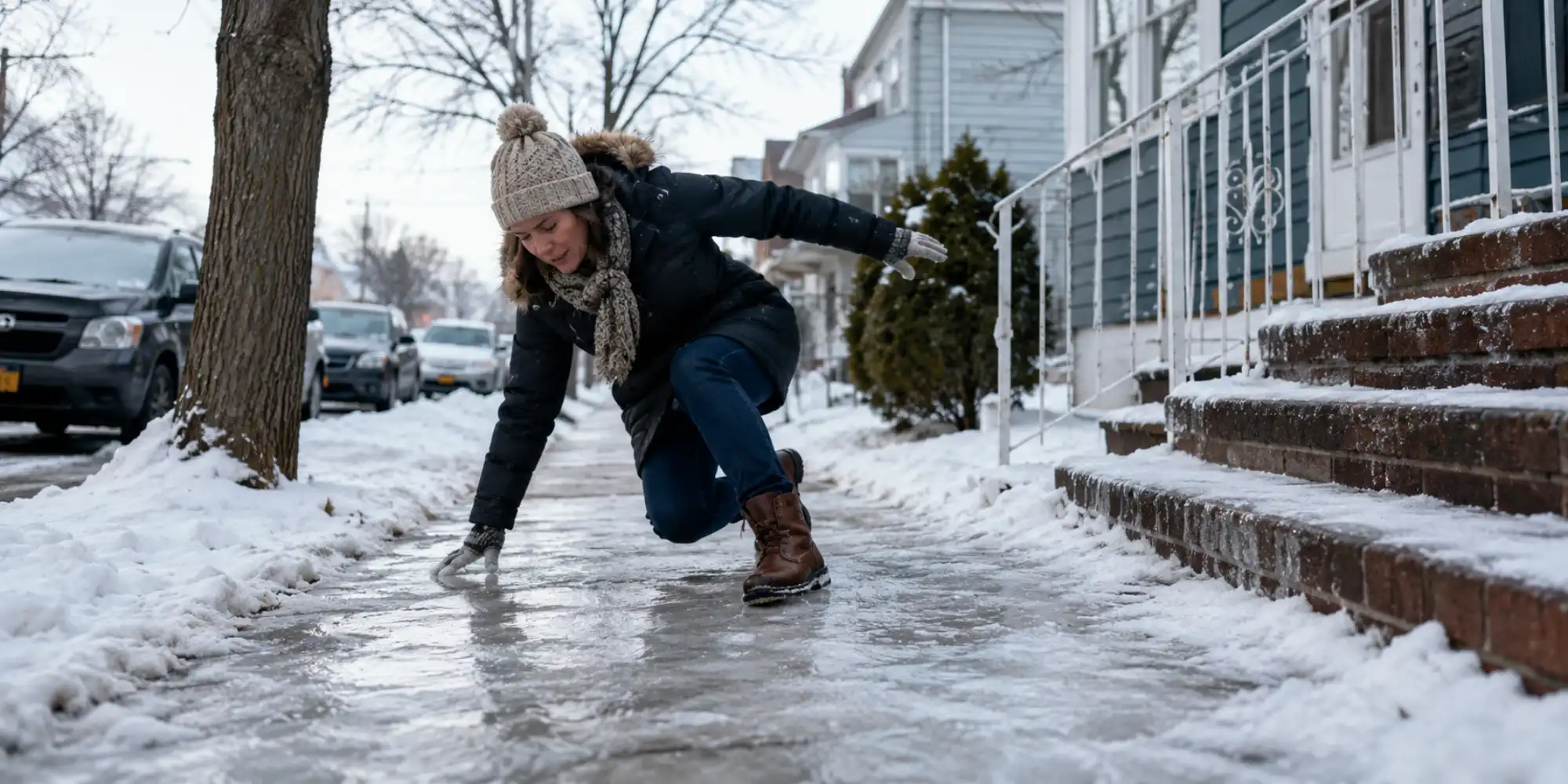
Explains the ongoing storm rule from Pareja v. Princeton International (no duty to clear ice mid-storm, only within a reasonable time after), its two exceptions, and why residential homeowners usually aren't liable for public sidewalk ice.
Winter slip and fall cases in New Jersey run into a rule most people have never heard of until they are hurt: commercial property owners are generally not required to clear snow and ice while a storm is still happening, only within a reasonable time after it ends.
Whether a property owner is liable for your fall often depends less on how icy the ground was and more on the timing of the storm, who owns the property and what, if anything, the owner did to make conditions worse.
What Duty Does a Commercial Property Owner Have?
Under Stewart v. 104 Wallace Street, decided by the New Jersey Supreme Court in 1981, commercial landowners have a duty to maintain the sidewalks abutting their property in reasonably good condition and can be liable to pedestrians injured by their failure to do so. Two years later, in Mirza v. Filmore Corp, the Court extended that duty to explicitly include the removal or reduction of snow and ice hazards. This duty generally applies to parking lots, walkways and other publicly accessible areas of a commercial property, not just the sidewalk out front.
What Is the Ongoing Storm Rule?
In 2021, the New Jersey Supreme Court decided Pareja v. Princeton International Properties, adopting what is known as the ongoing storm rule. Under this rule, a commercial landowner's duty to remove snow and ice generally does not arise during an active storm, only within a reasonable time after the precipitation ends. The Court reasoned that requiring continuous snow removal while a storm is still in progress would impose an impossible burden, and noted that several neighboring states with similar climates had adopted the same approach.
Are There Exceptions to the Ongoing Storm Rule?
Yes, two narrow exceptions can still create a duty during an active storm. First, a commercial landowner can be liable if its own conduct increased the risk of injury, such as a partial snow removal effort that refreezes into a slicker, more dangerous surface than if nothing had been done at all. Second, a landowner can be liable if a hazardous condition existed on the property before the storm began. Courts have applied these exceptions narrowly, and ordinary, if imperfect, efforts like salting a lot with only minimal accumulation generally have not been enough to trigger liability mid-storm.
Attorney insight: Weather records and a property's own snow removal logs are often the deciding evidence in these cases. Establishing exactly when a storm began and ended, and what the property owner did or did not do afterward, is one of the first things I investigate.
Is a Homeowner Liable for Ice on Their Sidewalk?
Generally, no. New Jersey law places the duty to maintain public sidewalks on municipalities rather than individual homeowners, and a homeowner is typically not liable for naturally occurring snow or ice that accumulates on a public sidewalk abutting their property. This changes if a homeowner takes action that makes the condition worse than doing nothing at all, for example by shoveling in a way that leaves a hidden sheet of ice, or by directing water runoff onto the walkway where it later freezes.
Do Local Snow Removal Ordinances Matter?
Many New Jersey municipalities have local ordinances requiring property owners to clear snow from sidewalks within a set window, often 12 to 24 hours after a storm ends. Violating a municipal ordinance can result in a fine from the town, but it does not automatically create civil liability to an injured pedestrian on its own, particularly for a residential homeowner. These ordinances are still worth reviewing in any fall investigation, since courts have given them real weight when evaluating what counts as a reasonable response time for a commercial property.
How Does Shared Fault Affect Your Claim?
You can still recover damages even if you share some of the blame, but your compensation is reduced by your percentage of fault, and you are barred from recovering entirely if you are found more than half responsible. New Jersey follows a modified comparative negligence rule under N.J.S.A. 2A:15-5.1: if your damages total 100,000 dollars and you are found 20 percent at fault, your recovery drops to 80,000 dollars. Property owners frequently argue that visible ice should have been avoided, which makes documenting the exact conditions at the time of the fall especially important.
What Evidence Matters Most in These Cases?
Weather records showing exactly when a storm started and ended, a commercial property's snow removal contracts and service logs, photographs of the ice and surrounding conditions and any applicable municipal snow removal ordinance are often central to a winter slip and fall case. Because ice and snow conditions change quickly, documenting the scene as soon as possible after a fall, including the exact time and location, matters more in these cases than in almost any other type of premises liability claim.
How Long Do You Have to File a Claim?
In most cases you have two years from the date of the fall to file a lawsuit under N.J.S.A. 2A:14-2. If the property is owned or maintained by a government entity, such as a municipal parking lot or a public building, a much shorter 90 day notice of claim requirement can apply instead under the New Jersey Tort Claims Act.
How Can a Lawyer Help After a Fall on Ice?
I move quickly to secure weather records, snow removal contracts and service logs before they are discarded, and to establish exactly when a storm began and ended relative to your fall. From there I evaluate whether either exception to the ongoing storm rule applies, gather medical records and negotiate directly with the property owner's insurer, all on a no win no fee basis.
The Bottom Line
Winter slip and fall cases in New Jersey depend heavily on timing: when the storm started, when it ended and what the property owner did afterward. Understanding whether the ongoing storm rule applies, or whether one of its narrow exceptions might, is often the difference between a claim that succeeds and one that does not.
If you were hurt in a fall on ice anywhere in Passaic, Bergen, Essex or Morris County, I would be glad to review the weather conditions and the property's response and give you a straight answer on your options.



Answers, before you even call.
Have a question we didn't cover? Contact us anytime. Every consultation is free, confidential, and no-strings.

Hurt in New Jersey? Let's Talk.
James Vasquez gives injured people across New Jersey a free, no obligation case review. Tell us what happened and we'll walk you through your options and what your claim may be worth.
.png)
Reach us whatever way works for you.
Need to talk to someone right now?

Areas we serve



.jpg)