Evidence Needed for a Personal Injury Claim in New Jersey
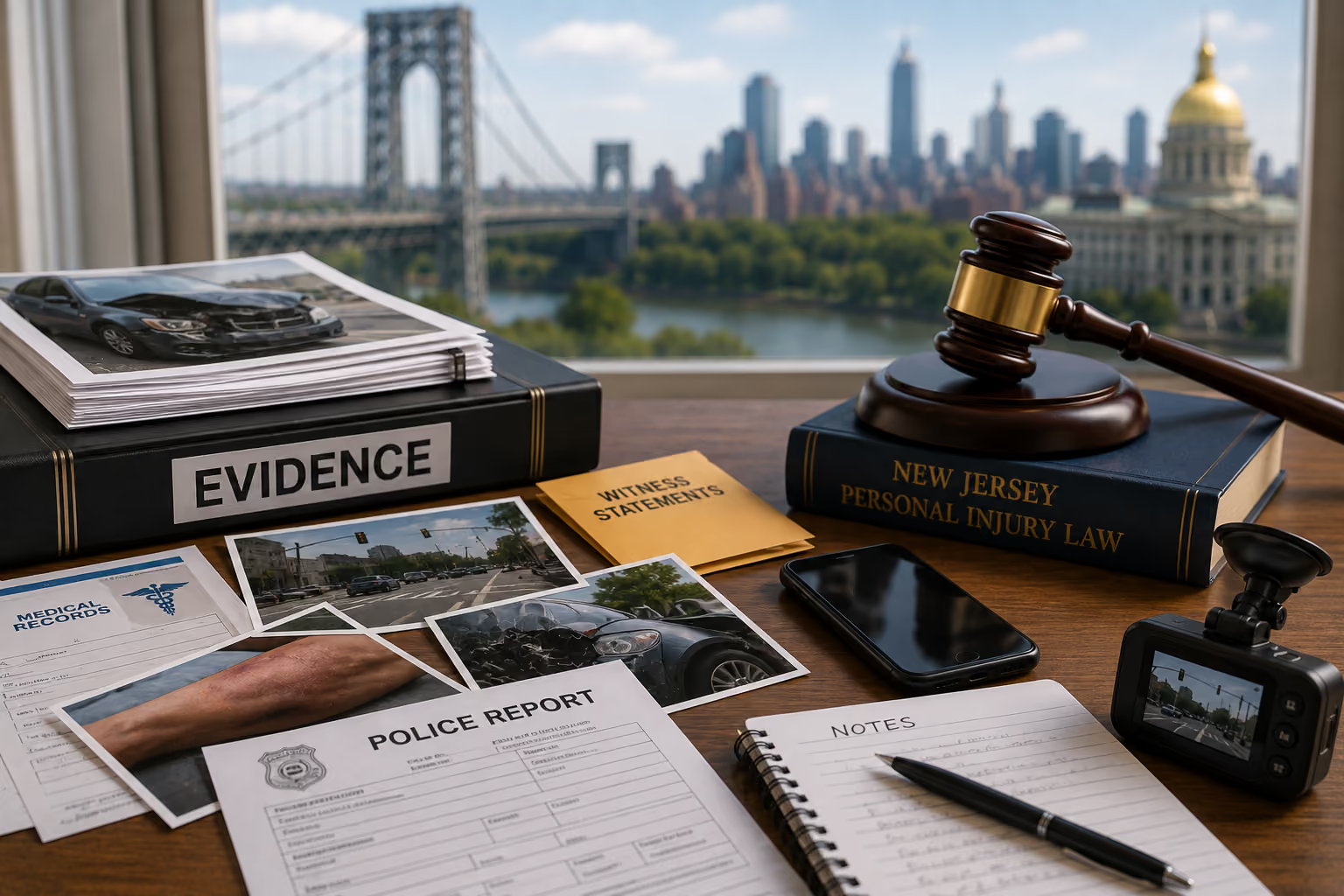
The strength of your personal injury claim is only as strong as the evidence behind it. Insurance companies do not simply take your word for what happened or how seriously you were hurt. This guide explains every category of evidence that matters, when to collect it and what happens when it disappears before you act.
When an insurance company gets your claim, it does not start by assuming you were badly hurt and looking for a fair way to pay you. It starts with skepticism and looks for reasons to minimize or deny. Your job, with your attorney, is to put up evidence that removes that skepticism and forces a realistic look at what you are owed.
I spent years as a New Jersey prosecutor building cases around evidence, and I bring that same discipline to every personal injury claim I handle in Passaic County and the surrounding communities. Here is the evidence a strong claim is built on, what each piece proves, and, just as important, how fast it disappears if no one moves to preserve it.
What Evidence Is Needed for a Personal Injury Claim in New Jersey?
Evidence falls into six categories: official reports, medical evidence, scene and visual evidence, witness evidence, economic loss documentation, and personal impact evidence. Serious injury cases add a seventh, expert witness reports. Each supports a different element of your claim and must be gathered and preserved as early as possible.
What Does Each Category of Evidence Include?
Every category supports a different part of your claim. Here is what each contains and how to secure it before it disappears.
Official reports
These create the authoritative third-party record, and they are the first thing an insurer requests and a court reviews. Calling police to any injury accident is non-negotiable.
- Police report with the officer's observations and diagram
- Incident report from a business, property owner or employer
- OSHA or workplace injury form for on-the-job accidents
- Fire or EMS reports if emergency services responded
- Property maintenance logs and prior complaint history for premises claims
Medical records and bills
Medical evidence is the backbone of the claim. It shows what you suffered, connects it to the accident and documents the cost. Completeness directly affects both liability and damages.
- ER or urgent care records from the day of the accident
- All imaging, including X-rays, MRIs and CT scans
- Primary care, specialist, and physical or occupational therapy notes
- Surgical records and mental health treatment records where relevant
- Treating physician's prognosis and future care letter, plus itemized bills
Scene photographs and video
Photos taken at the scene are among the most persuasive evidence you can have, because they capture reality before conditions change. Take far more than you think you need.
- Wide overview shots and close-ups of the impact point or hazard
- All vehicle damage from multiple angles
- Skid marks, debris, signage, signals and lighting
- Visible injuries at the scene, then daily for the first two weeks
- Locations of any nearby security or traffic cameras
Surveillance and camera footage
Footage from nearby businesses, traffic cameras, dashcams and doorbells is often the single most powerful evidence in a disputed case, because it shows what happened without relying on anyone's account. The problem is timing, which I cover in the preservation timeline below.
- Retail, restaurant and gas station security cameras
- Municipal traffic or intersection cameras
- Dashcam footage from other vehicles
- Residential doorbell and parking lot cameras
- Bus or transit authority footage near a route
Witness statements
Independent witnesses give your claim credibility no attorney can manufacture. Collect contacts at the scene, even from people who say they did not see everything.
- Full name, phone and email for every witness
- A brief note on what each one saw while it is fresh
- Formal written statements obtained by your attorney later
- Family, coworker and friend accounts of your changed activity and capacity
Economic loss documentation
This turns a general injury claim into a specific financial demand. Every dollar you document is a dollar the insurer must account for.
- Itemized medical bills by provider and date
- Pay stubs from before and after, plus an employer letter on missed work and pay rate
- Self-employment income records where applicable
- Receipts for out-of-pocket costs, transportation and hired household services
- Vehicle repair estimates and a physician letter projecting future costs
Personal impact evidence
Non-economic damages are often the largest part of a serious settlement and the hardest to prove without consistent documentation. The main tool is a daily injury journal.
- Daily journal of pain levels and functional limitations
- Specific activities, events, hobbies or travel you missed
- Impact on sleep, mood and family relationships
- Progressive injury photos and any mental health records
How Do I Preserve Evidence After a Truck Accident in New Jersey?
Contact an attorney immediately so legal preservation letters go to the trucking company demanding it keep the electronic control module data, driver logs, GPS data, maintenance and inspection records, and drug and alcohol testing. Much of this is destroyed under routine retention policies within 30 to 90 days unless formally preserved.
Truck cases carry a whole layer of evidence that car cases do not. Commercial trucks are governed by federal and state rules on driver hours, maintenance, loading and operator qualification, and a violation of those rules is powerful evidence of negligence. The catch is timing. Electronic control module (black box) data may be overwritten after about 30 days. Under the Federal Motor Carrier Safety Administration rules, a carrier must retain driver records of duty status for only six months (49 CFR 395.8). Wait too long and the evidence that proves fault is legally gone.
What Evidence Disappears, and When?
Knowing when evidence becomes unavailable is one of the most valuable things an injured person can understand. This reflects actual retention practice in New Jersey cases.
The lesson in that table is the same one I give every caller: the earlier a lawyer is involved to send preservation letters, the more of this survives to build your case on.
How Do Expert Witnesses Strengthen a Serious Injury Case?
Experts provide professional testimony beyond what a lay adjuster or jury understands, which signals a credible, hard-to-challenge claim and drives better offers before trial. In serious cases, the difference between expert and no expert is often tens of thousands of dollars.
In a straightforward case with clear liability and modest injuries, you may not need them. In a serious or disputed case, the right expert changes the outcome:
- Medical expert. Opines on the nature, cause, permanency and future cost of your injuries. Needed for serious, permanent or disputed injuries.
- Accident reconstruction specialist. Uses physical evidence and engineering to rebuild how the crash happened. Needed for disputed liability, truck, pedestrian and high-speed cases.
- Economic or vocational expert. Calculates lifetime lost earnings and future care costs. Needed for permanent disability, young claimants or complex self-employment income.
- Premises liability expert. Opines on building codes and safety standards. Needed for slip and falls and other premises cases where foreseeability is contested.
- Trucking industry expert. Addresses FMCSA compliance and company practices. Needed where corporate negligence in hiring, training or maintenance contributed.
- Life care planner. Itemizes lifetime medical and personal care needs. Needed for catastrophic injuries like spinal cord damage or brain injury.
What Evidence Mistakes Damage Personal Injury Claims?
The same avoidable mistakes appear over and over, and each one weakens otherwise strong cases. Right guidance from the start prevents all of them.
- Leaving the scene without witness contacts. Once a witness walks away, they may be impossible to find. Get names and numbers first.
- Not photographing before vehicles are moved. The impact point disappears once cars are relocated. Shoot it before anything moves, even if you must clear the lane after.
- Waiting days to ask about surveillance. The 24 to 72-hour window is not flexible. Waiting three days usually means the footage is already overwritten.
- Stopping treatment before maximum medical improvement. Quitting while still symptomatic understates your injuries, and insurers call it recovery.
- Never starting an injury journal. Without a contemporaneous record, non-economic damages are hard to prove with the specificity insurers respect.
- Posting on social media. Activity posts that look inconsistent with your injuries get used against you. Pause non-essential social media until the case ends.
- Hiding pre-existing conditions. Concealing a prior injury destroys your credibility if discovered. Disclose it, and let your attorney frame the aggravation properly.
Conclusion
A personal injury claim is only as strong as the evidence behind it, and the best evidence is also the most perishable. Footage is overwritten in a day, skid marks wash away, witnesses scatter, and truck data is purged on a schedule. The insurer is in no hurry to preserve any of it for you.
That is why the single most valuable step after an injury is getting a lawyer involved early, while there is still something to preserve. The consultation is free, there is no obligation, and there is no fee unless we recover money for you.
Related Articles and Resources




Answers, before you even call.
Have a question we didn't cover? Contact us anytime. Every consultation is free, confidential, and no-strings.

Hurt in New Jersey? Let's Talk.
James Vasquez gives injured people across New Jersey a free, no obligation case review. Tell us what happened and we'll walk you through your options and what your claim may be worth.
.png)
Reach us whatever way works for you.
Need to talk to someone right now?

Areas we serve



.jpg)