4 Elements of Negligence: What You Must Prove to Win

To win a personal injury case based on negligence, you must prove four things: duty of care, breach of that duty, causation and damages. Miss even one and the claim fails, no matter how obvious the other party's carelessness might seem.
As a personal injury attorney, I work through these four elements in every case I take on. Understanding what each one requires, and where cases most often fall apart, is the difference between a strong claim and one the defense can dismantle early. This guide walks through all four elements, how they connect, the different types of negligence you need to know about and the mistakes injured people make that give the defense an opening.
What are the four elements of negligence?
Negligence, in legal terms, is a failure to use reasonable care under the circumstances that results in harm to another person. Black's Law Dictionary defines it as the failure to exercise the standard of care that a reasonably prudent person would have exercised in a similar situation. Simply put, it means someone acted carelessly and someone else got hurt because of it.
To succeed on a negligence claim, the injured person, called the plaintiff, must prove all four elements by a preponderance of the evidence. The defendant does not have to prove they were careful. The burden rests entirely on the injured party throughout. Think of the four elements as four locks on a door. You need the right key for every single one.
- Duty of care: The defendant owed a legal obligation to the injured person.
- Breach of duty: The defendant failed to meet that obligation.
- Causation: The defendant's breach directly caused the accident and the injuries.
- Damages: The injured person suffered real provable losses as a result.
These four elements apply across virtually every type of personal injury case, from car accidents and slip and falls to truck accidents and wrongful death claims. The facts and evidence differ depending on the case type, but the framework is always the same.
Element 1: What is duty of care?
Duty of care is the legal obligation a person or entity has to act with reasonable care to avoid causing foreseeable harm to others. This is not a moral obligation or general courtesy. It is a legally recognized responsibility that courts enforce.
Duty shows up constantly in everyday situations. Every driver on the road owes a duty to operate their vehicle safely and follow traffic laws. Property owners owe a duty to keep their premises reasonably safe for visitors. Doctors owe a duty to provide care that meets the accepted standard in their medical specialty. Businesses owe a duty to protect customers from foreseeable hazards on their property.
Courts determine whether a duty existed by looking at the relationship between the parties and whether the potential for harm was reasonably foreseeable. If a reasonable person in the defendant's position should have known their actions could lead to someone getting hurt, a duty of care almost certainly existed. The existence of a duty is the foundation on which everything else in a negligence claim is built.
Element 2: What is breach of duty?
Once duty is established, the next step is showing that the defendant breached it. A breach occurs when someone fails to do what a reasonably prudent person would have done under the same circumstances, or when they do something a reasonable person would not have done. The legal standard is not perfection. It is reasonableness.
Breach looks different depending on the type of case. A driver who was texting at the moment of a crash breached their duty to operate a vehicle safely. A property owner who ignored repeated complaints about a broken staircase railing breached their duty to maintain safe premises. A doctor who failed to order a standard screening test for an obvious set of symptoms may have breached the medical standard of care.
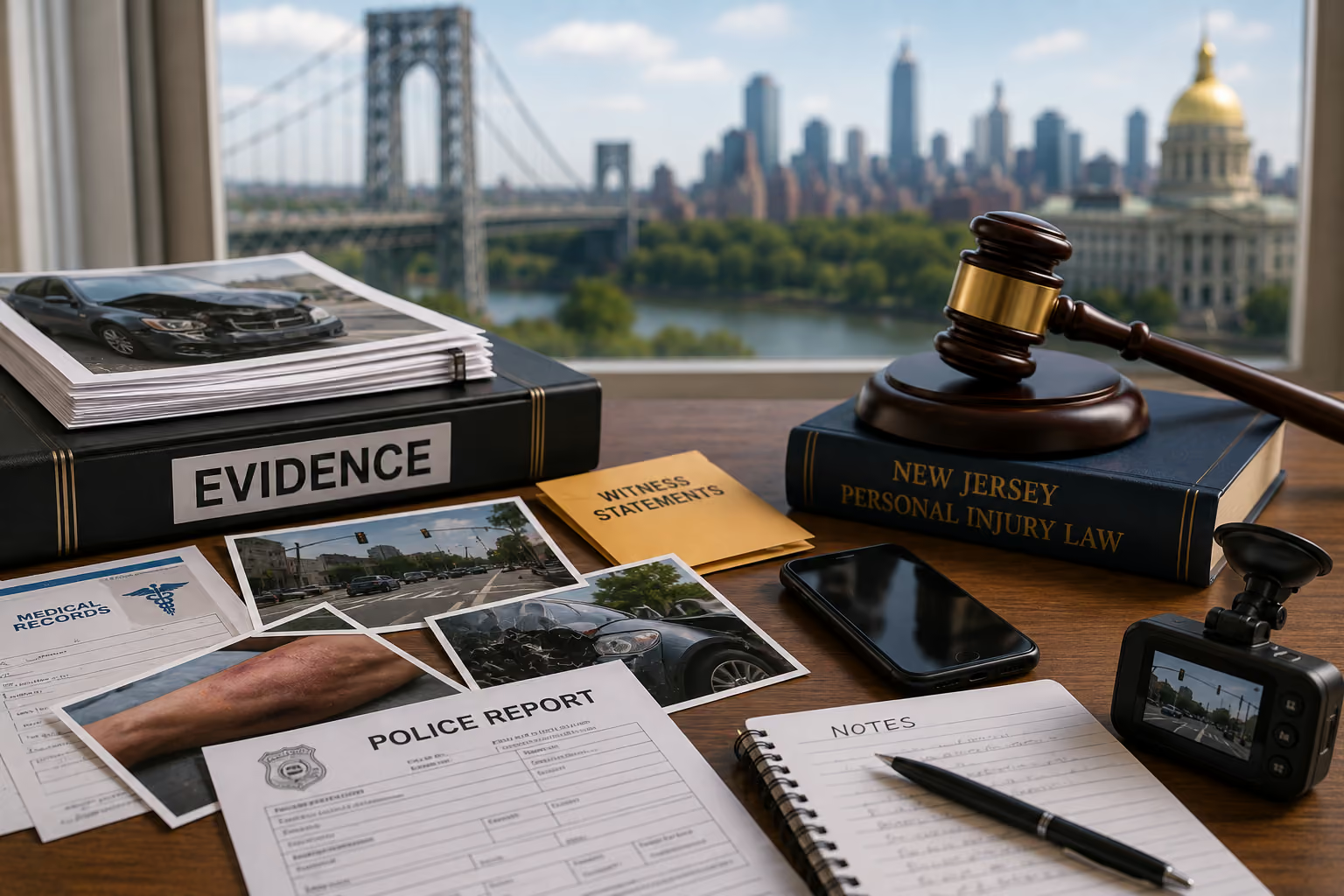
Proving breach requires solid evidence. Police reports and incident reports document what happened and often include an initial assessment of fault. Witness statements provide independent accounts of the defendant's behavior. Surveillance footage can be particularly powerful when it captures the exact moment of an incident or shows a hazard that had been present for a long time. In technical cases like medical malpractice or product liability, expert testimony is often necessary to explain what the proper standard of care was and how the defendant fell short of it.
Element 3: What is causation and how does the but-for test work?
Proving that the defendant owed you a duty and violated it is still not enough on its own. Causation requires you to show that the defendant's breach directly caused your accident and your specific injuries. It is not enough to show that someone acted carelessly in general. You have to connect their specific careless act to the specific harm you suffered.
The most common legal test for causation is the "but-for" test: but for the defendant's negligent conduct, would the injury have occurred? If the answer is no, then cause-in-fact is established. Alongside this is the concept of proximate cause, which asks whether the type of harm that occurred was a foreseeable result of the defendant's actions. If a driver runs a red light and strikes your car, it is entirely foreseeable that someone in the other vehicle could be injured. That foreseeability is what makes the driver's breach the proximate cause of your injuries rather than just one event in a chain.
Causation is where insurance companies push back the hardest. Adjusters frequently argue that an injury was caused by a pre-existing condition rather than the accident, or that gaps in treatment suggest the injury wasn't as serious as claimed. This is why medical records created close in time to the accident are critical, along with physician opinions that connect your condition to the incident and expert testimony when the mechanism of injury requires explanation.
Element 4: What damages can you recover?
Damages refers to the actual losses you suffered as a result of the defendant's negligence. Without real provable harm, there is no negligence claim. Even if someone acted with complete recklessness, the law provides no remedy if you walked away without any injuries, medical bills, lost income or other measurable losses.
Damages in personal injury cases fall into two main categories.
Documenting damages from the very beginning of a case matters enormously. Every medical bill, every missed workday, every receipt for out-of-pocket expenses and every journal entry describing daily pain and limitations contributes to the damages picture a jury or insurer will evaluate.
What is the burden of proof in a negligence case?
In a civil personal injury case, the standard of proof is called preponderance of the evidence. This means the injured person must show it is more likely than not that the defendant's negligence caused their injuries and losses, often described as a greater than 50 percent likelihood. This is significantly lower than the beyond a reasonable doubt standard used in criminal cases, but that does not make it easy to meet.
The burden applies to every element individually. You can have overwhelming proof of duty and breach, but if your causation evidence is weak, the defendant can still win. Similarly, well-documented damages mean nothing if you cannot show the defendant actually breached a duty of care. Each element stands on its own and the plaintiff must carry the burden on all four. This is why building a complete well-supported case matters from the very first day after an accident.
What evidence do you need to prove the four elements?
The types of evidence you need vary depending on the case, but there are common categories that apply across most personal injury claims. Starting to gather evidence as soon as possible after an accident is one of the most important steps an injured person can take.
Real-world examples: how the four elements apply
The four-element framework applies to every type of personal injury case. The facts and evidence differ, but the structure stays the same.
In a car accident case, a driver has a duty to follow traffic laws and operate their vehicle safely. A driver who was texting and ran a red light breached that duty. When their vehicle struck yours in the intersection, that collision was the direct cause of your injuries. The emergency room visit, follow-up care, weeks of missed work and pain and suffering are your damages. All four elements are present and supported by specific documentable facts.
A slip and fall case follows the same structure. A store has a duty to keep its floors reasonably safe. An employee who notices a spill near the entrance but leaves it for an hour without cleaning it up or posting a warning sign has breached that duty. When you walk through and fall on the wet floor, the fall is the causation event. Your fractured wrist, physical therapy costs and lost income while you couldn't work are your damages. The key evidence would be the incident report, surveillance footage showing how long the spill was present, witness statements and your medical records.
In a truck accident case, the same four elements apply, though the duty analysis may extend beyond just the driver to include the trucking company if it failed to properly maintain the vehicle, enforce rest requirements or screen its drivers. These cases often involve multiple parties sharing responsibility for a single breach.
What are the different types of negligence?
Standard negligence is a failure to use reasonable care. Beyond that, several other classifications of negligence come up regularly in personal injury cases and can significantly affect both how a claim is proven and what compensation is available.
Gross negligence is a more extreme form, where the defendant lacked even slight diligence or care. It goes beyond a simple mistake into conduct that shows a reckless disregard for the safety of others. Gross negligence can support a claim for punitive damages in addition to standard compensatory damages.
Willful and wanton negligence describes conduct where the defendant was aware of their actions and knew or should have known those actions would likely cause injury to another person. A road rage incident where a driver deliberately uses their vehicle to endanger others is one example. Like gross negligence, willful and wanton conduct can open the door to punitive damages.
Vicarious negligence, also called vicarious liability, is when someone who did not directly cause the harm is still held legally responsible for it. The most common example is an employer whose employee causes an accident while on the job. If a delivery driver rear-ends another vehicle while making a delivery during work hours, the employer may share liability for the driver's negligence. This is an important distinction in cases involving commercial drivers and company vehicles.
What is negligence per se?
Negligence per se is a legal doctrine that applies when a defendant violates a law or statute specifically designed to protect people from harm, and that violation causes someone's injury. Unlike standard negligence, where you must prove the defendant acted below a reasonable standard of care, negligence per se makes the violation of the law itself sufficient to establish the breach element. You still need to prove causation and damages, but the breach is treated as established.
Texting while driving is a common example. Distracted driving laws exist specifically to prevent the type of harm that comes from inattentive operation of a vehicle. A driver who was texting at the moment of a crash has violated a statute designed to protect other road users. That violation establishes negligence per se, removing one of the four elements from dispute and allowing the case to focus on causation and the extent of damages.
Negligence per se can also arise from violations of building codes, OSHA safety regulations, product safety standards or any other law or ordinance enacted to prevent the specific type of harm that occurred.
What is comparative negligence and how does shared fault affect your claim?
In many accidents, more than one party shares some degree of fault. The legal framework for handling shared fault varies significantly by state and can have a major impact on the compensation you can recover.
Pure comparative negligence allows an injured person to recover damages even if they were 99 percent at fault, though their recovery is reduced by their percentage of fault. A small number of states follow this rule.
Modified comparative negligence is the standard in most states. It allows recovery as long as the plaintiff's fault is below a threshold, typically 50 or 51 percent. Once that threshold is crossed, recovery is barred entirely. New Jersey follows modified comparative negligence at the 50 percent bar under N.J.S.A. 2A:15-5.1, meaning an injured person who is found 50 percent or more at fault cannot recover any compensation.
Contributory negligence is the harshest standard and is still followed in a small number of states. Under this rule, any fault on the part of the injured person, even one percent, completely bars recovery.
RuleHow it worksStatesPure comparative negligenceRecovery allowed at any fault level, reduced proportionallyCalifornia, New York and othersModified comparative negligence (50% bar)Recovery barred if plaintiff is 50% or more at faultNew Jersey and most statesModified comparative negligence (51% bar)Recovery barred if plaintiff is 51% or more at faultVaries by stateContributory negligenceAny fault by plaintiff bars recovery entirelyVirginia, Maryland, Alabama and a few others
Because insurance adjusters know which state's rules apply, they will often attempt to assign as much fault as possible to the injured person to reduce what they owe. This is one of the most common tactics I see in cases involving car accidents and slip and falls, where the facts around shared fault are frequently disputed.
What are the most common mistakes that hurt a negligence claim?
Most of the mistakes that damage a personal injury claim happen in the days and weeks immediately after the accident, before the injured person has had a chance to speak with an attorney.
Delaying medical treatment is probably the most damaging. Insurance companies use gaps in care as evidence that the injuries were not serious or were not caused by the accident at all. Even if you feel reasonably okay after a crash, getting evaluated promptly creates a medical record that connects your condition to the incident. Some injuries, including traumatic brain injuries and soft-tissue damage, do not produce obvious symptoms right away.
Failing to document the scene is another common and often irreversible mistake. Photos of the vehicles, the road conditions, any hazard that caused a fall, your visible injuries and surrounding details are evidence that disappears quickly. Witness contact information is equally valuable and equally easy to lose if not collected at the scene.
Giving recorded statements to insurance adjusters without first speaking to an attorney is a significant risk. Adjusters are skilled at asking questions in ways that elicit statements that minimize fault or suggest you bear some responsibility. Even a casual remark that you "didn't see it coming" can be used to argue you were not paying attention.
Stopping treatment early or missing follow-up appointments gives the defense grounds to argue that your injuries were not as serious as claimed or that you failed to take reasonable steps to recover. Following your doctor's treatment plan is important both for your health and for preserving the integrity of your damages claim.
How does a personal injury lawyer help prove all four elements?
A personal injury attorney's job is to take the facts of what happened and map them onto all four elements in a way that meets the civil burden of proof. That starts with a thorough analysis of duty, breach, causation and damages, identifying the strengths and weaknesses of the case early and developing a strategy that addresses the arguments the defense is likely to make.
The practical work involves gathering police reports, medical records, employment records and incident reports. Witnesses are interviewed while their memories are still fresh. Medical experts explain the nature and cause of injuries. Accident reconstruction specialists analyze crash mechanics when the sequence of events is disputed. The full scope of damages is calculated, including future medical costs and long-term impacts on earning capacity that injured people often underestimate when handling a claim on their own.
Legal representation matters most when liability is disputed, injuries are serious or permanent, or multiple parties may share responsibility. In those situations the stakes are high and the legal complexities multiply quickly. I handle personal injury cases on a no win no fee basis, which means there is no cost to getting a professional evaluation of how the four elements apply to your specific situation.
Conclusion
Every personal injury claim ultimately comes down to these four elements: duty, breach, causation and damages. Understanding what each one requires, what evidence supports it and where claims commonly fall apart puts you in a much stronger position from the moment an accident happens. Document everything, get medical attention promptly, be careful about what you say to insurance companies and understand that the strength of your case depends on how completely you can establish all four elements.
If you were injured because of someone else's negligence, my office handles personal injury cases on a no win no fee basis and offers free consultations. Call 862-247-8711 to discuss how the four elements apply to your situation
Related Articles and Resources



Answers, before you even call.
Have a question we didn't cover? Contact us anytime. Every consultation is free, confidential, and no-strings.

Hurt in New Jersey? Let's Talk.
James Vasquez gives injured people across New Jersey a free, no obligation case review. Tell us what happened and we'll walk you through your options and what your claim may be worth.
.png)
Reach us whatever way works for you.
Need to talk to someone right now?

Areas we serve



.jpg)