Rahway Car Accident Lawyer Union County, New Jersey
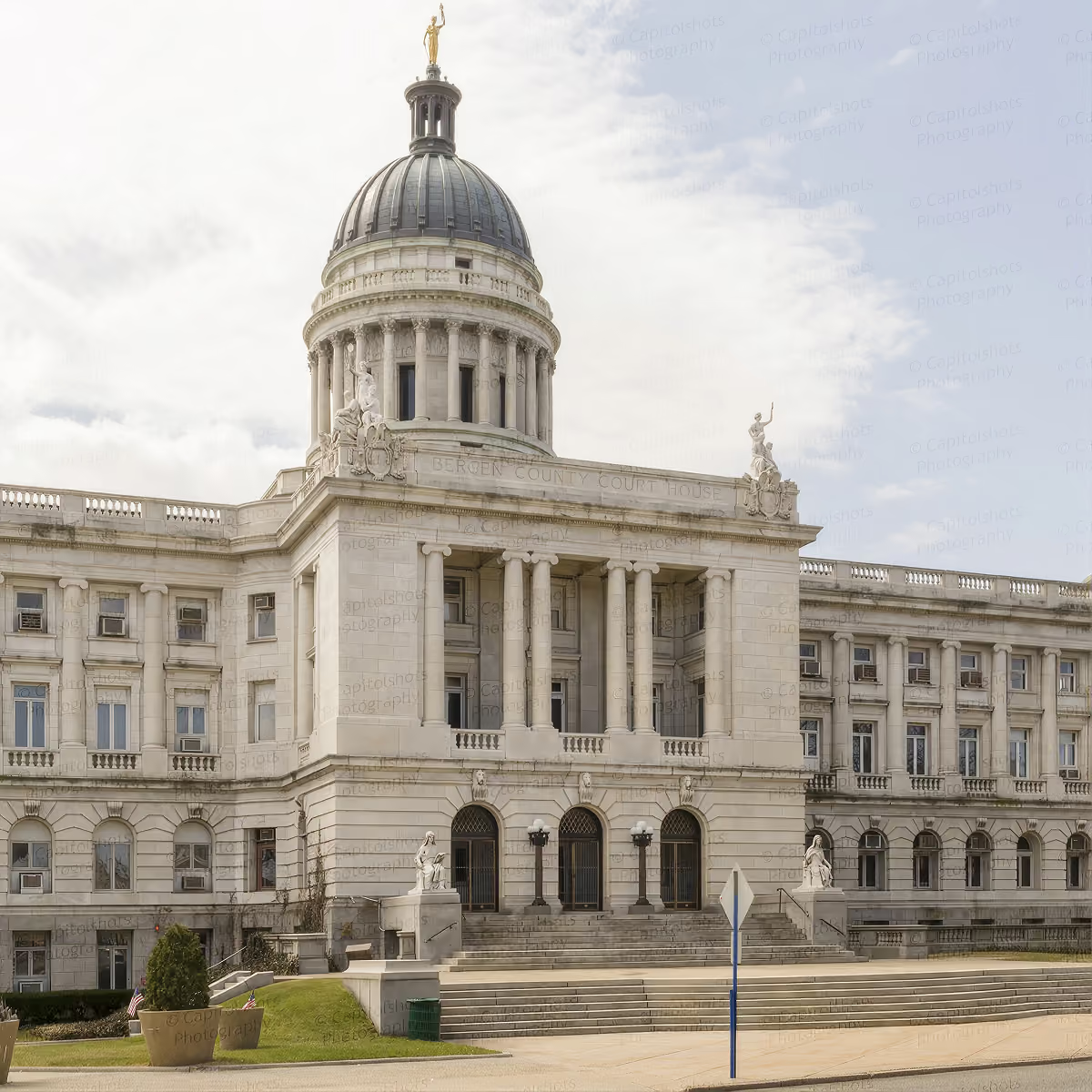
If you were hurt in Hackensack, James Vasquez fights to get you every dollar you are owed. He has represented Bergen County's injured since 2004, and he knows this county seat's I-80, Route 4 and Route 17 corridors, its historic Hackensack River bridges, and the streets around Main Street and Hackensack University Medical Center.
.avif)
Where federal law takes the argument away
.avif)
.svg)
Rahway sits on a main rail corridor, and grade crossing collisions here are governed by a framework most people, and a good many lawyers, do not expect.
The Supreme Court has held twice that federal railroad safety law displaces particular state law claims. In 2000 it held that where federal funds participated in installing the warning devices at a crossing and those devices are in place, state tort claims that the devices were inadequate are preempted. Seven years earlier it held that a claim the train was travelling too fast is preempted where the train was within the federal speed limit for that class of track. Those are the two arguments an injured person instinctively reaches for, and both can be gone before the case starts. What remains is substantial and it is easy to miss. Preemption of those particular claims does not immunise a railroad from everything. Allegations about failing to sound a warning, failing to brake in time, vegetation obstructing sight lines at the approach, and the condition of the crossing surface itself sit outside the regulations that displaced the warning device claim. Claims against the road authority rather than the railroad are a separate route again. There is also a New Jersey specific point. Where a public transit operator is involved, a notice requirement measured in weeks rather than years applies. James Vasquez has handled New Jersey injury claims since 2004.
Rahway car accident claims we take on
Crossing collisions are handled differently from everything else on this list.

Where Rahway collisions happen
A rail city with a highway corridor and a compact centre.
Station approaches
Concentrated activity twice a day with vehicles dropping off, circling and pulling out among pedestrians heading for trains.
What to establish first: whether a public transit operator was involved in any way, which shortens the deadline dramatically.

The downtown grid
Retail frontage with vehicles stopping and turning, producing frequent moderate speed impacts.
What to establish first: camera coverage from businesses, which records continuously and overwrites within days.

Grade crossings
Level crossings on the corridor through the city, where the applicable law depends on what devices are installed and how they were funded.
What to establish first: which devices were present and whether federal funds participated in installing them, because that determines which claims survive.
Route 1 and 9
Merging and exiting traffic at sustained speed with jughandle turns, where the injuries are the most severe in the city.
What to establish first: the coverage available, because serious injuries on this corridor routinely exceed minimum liability limits.
The crossing cases are the ones where the legal framework has to be worked out before anyone argues about how the collision happened.
Four things to establish before assuming anything
The answers decide which arguments are available rather than how strong they are.
What devices were there
Crossbucks and advance warning signs, or automatic gates and flashing lights. The type installed is the starting point of the whole analysis.
Whether federal funds paid for them
Where federal funds participated in installation and the devices are in place, a claim that the devices were inadequate is preempted.
Whether they were actually installed
This distinction matters. In the earlier Supreme Court case the warning device claim survived precisely because the federally funded devices had not been installed.
The train's speed against the track class
A claim that a train was travelling too fast is preempted where it was within the federal speed limit for that class of track.
None of this is apparent at the scene, and all of it is discoverable. It is why a crossing case should be assessed before assumptions harden. For how car accident claims work statewide, see the car accident practice area page.
Two categories preemption does not reach
Preemption of particular claims is not immunity, and the distinction is where these cases are actually won.

Conduct rather than devices
Allegations that a warning was not sounded, that brakes were not applied in time, or that the crossing was operated negligently address conduct rather than the adequacy of installed equipment. In the very case that established the warning device preemption, those allegations were pleaded alongside and were not the subject of the holding. They depend on locomotive recordings and crew records, which is why a preservation demand should go out immediately rather than after the legal framework has been worked out.
Sight lines, vegetation and the crossing surface
Growth obstructing the view of an approaching train, and the physical condition of the crossing surface and its approaches, sit outside the regulations governing warning device adequacy. These are maintenance questions, and responsibility for them may lie with the railroad, with the road authority, or with both. They are also the most perishable evidence in the case, because vegetation is cut and surfaces are repaired within weeks of a serious collision.
Three rules at a railroad crossing
Federal decisions plus one New Jersey deadline. Confirm current authority before relying on any of it.
Warning device claims can be preempted
The Supreme Court held that federal railroad safety law, together with the federal highway regulations on warning devices, preempts state tort claims that a railroad failed to maintain adequate warning devices at crossings where federal funds participated in the devices' installation and those devices are in place.
Speed claims within the federal limit
A claim that a train was travelling at an excessive speed is preempted where the train was within the federal speed limit for that class of track. In that case the warning device claim survived only because the federally funded devices had not actually been installed.
Ninety days where a public operator is involved
Where a public transit operator or other public entity may be involved, a formal notice of claim is generally required within 90 days of the incident as a condition of bringing suit. That is the operative deadline rather than the ordinary two years.
Personal Injury Protection, the verbal threshold and uninsured motorist claims are covered on the car accident practice area page and the Rahway personal injury page.
What to do after a crossing collision
Two clocks run at once, and neither is the two year one.
Photograph the crossing and its approaches
Devices, signage, sight lines and vegetation. All of it changes within weeks of a serious collision and none of it can be recreated.
Send a preservation demand immediately
Locomotive event recordings, crew records and any forward facing footage. These have their own retention cycles and are not held for you.
Treat ninety days as the deadline
Where a public transit operator may be involved, that is the period that governs whether a claim can be brought at all.
Do not assume the case is hopeless
Preemption removes particular arguments rather than immunising a railroad, and the surviving categories are frequently the stronger ones anyway.

.avif)

James Vasquez
Before James Vasquez ever represented an injured person, he sat on the other side of the table. As a former prosecutor and insurance-defense attorney, he spent years learning exactly how these cases are won and lost.
Now he uses it for you. When adjusters and opposing counsel face James, they're facing someone who has read their playbook, argued in their courtrooms, and knows precisely where their arguments break.
Based in Clifton and serving Passaic, Morris, and Essex Counties, his firm gives every client James's personal attention, backed by a team that knows your file cold.
Answers, before you even call.
Anything else you’d like to know? Get in touch with our sales team and we’d be happy to discuss your questions.


Hear Our Clients’ Stories

James Vasquez was the first name everyone recommended. People told me he would make sure I was taken care of, and they were right. The team was friendly, professional, down to earth, and experienced. They handled everything, and all I had to do was listen, follow their guidance, and focus on my recovery. One of the best parts of the experience was working with the paralegal, John Velazquez. Whenever I had questions, he would stop what he was doing, sit down with me, and explain everything in detail. I never felt rushed, and I always felt that my concerns were fully answered. He helped me understand every step of the legal process, and I truly felt like I had a friend inside the firm."
Kraig Moultrie


Hear Our Clients’ Stories
After the accident at work, my health and my ability to work changed dramatically. I faced many challenges because I could no longer do the same things I used to do. Before receiving help, I was afraid because my health wasn't improving, and I didn't know what to do. The insurance company made things difficult, asking me questions I didn't know how to answer, and I felt lost and overwhelmed. Then I found this team, and from the very first conversation they gave me confidence and explained everything clearly. They guided me through the entire treatment process, helped me access the medical care I needed, and supported me every step of the way."
Martina Contreras

What it's actually like to work with us
We'll skip the sales pitch. This is what it's actually like to have James in your corner; straight from the people who've been there.

"Staff is very Friendly. They keep you informed on a regular basis. The Attorneys are the best. Would recommend this Law firm to anyone."


"James Vasquez is one of the best Lawyers. He knows what he's doing at all times, very Professional along with his staffs that entire office has very good attitude. He keeps you updated and gives good advise he did very good with my case and I highly recommend him. He deserves more than five stars!"
"James Vasquez and his team took care of my case like if it was their own. I was able to take care of my car accident case, and even during this pandemic. I never felt pressured, and they were definitely patient with my case."
"Throughout this process, James and I kept in touch via email, and he offered his guidance every step of the way."
"I would highly recommend anyone to hire him!"
"Mr. Vasquez was able to recover a good settlement for me and he recommended me to great medical professionals to help with my back and neck injuries."
James Vasquez was the first name everyone recommended. People told me he would make sure I was taken care of, and they were right. The team was friendly, professional, down to earth, and experienced. They handled everything, and all I had to do was listen, follow their guidance, and focus on my recovery. One of the best parts of the experience was working with the paralegal, John Velazquez. Whenever I had questions, he would stop what he was doing, sit down with me, and explain everything in detail. I never felt rushed, and I always felt that my concerns were fully answered. He helped me understand every step of the legal process, and I truly felt like I had a friend inside the firm."
After the accident at work, my health and my ability to work changed dramatically. I faced many challenges because I could no longer do the same things I used to do. Before receiving help, I was afraid because my health wasn't improving, and I didn't know what to do. The insurance company made things difficult, asking me questions I didn't know how to answer, and I felt lost and overwhelmed. Then I found this team, and from the very first conversation they gave me confidence and explained everything clearly. They guided me through the entire treatment process, helped me access the medical care I needed, and supported me every step of the way."
"Staff is very Friendly. They keep you informed on a regular basis. The Attorneys are the best. Would recommend this Law firm to anyone."
"James Vasquez is one of the best Lawyers. He knows what he's doing at all times, very Professional along with his staffs that entire office has very good attitude. He keeps you updated and gives good advise he did very good with my case and I highly recommend him. He deserves more than five stars!"
"James Vasquez and his team took care of my case like if it was their own. I was able to take care of my car accident case, and even during this pandemic. I never felt pressured, and they were definitely patient with my case."
"Throughout this process, James and I kept in touch via email, and he offered his guidance every step of the way."
"I would highly recommend anyone to hire him!"
"Mr. Vasquez was able to recover a good settlement for me and he recommended me to great medical professionals to help with my back and neck injuries."
James Vasquez was the first name everyone recommended. People told me he would make sure I was taken care of, and they were right. The team was friendly, professional, down to earth, and experienced. They handled everything, and all I had to do was listen, follow their guidance, and focus on my recovery. One of the best parts of the experience was working with the paralegal, John Velazquez. Whenever I had questions, he would stop what he was doing, sit down with me, and explain everything in detail. I never felt rushed, and I always felt that my concerns were fully answered. He helped me understand every step of the legal process, and I truly felt like I had a friend inside the firm."
After the accident at work, my health and my ability to work changed dramatically. I faced many challenges because I could no longer do the same things I used to do. Before receiving help, I was afraid because my health wasn't improving, and I didn't know what to do. The insurance company made things difficult, asking me questions I didn't know how to answer, and I felt lost and overwhelmed. Then I found this team, and from the very first conversation they gave me confidence and explained everything clearly. They guided me through the entire treatment process, helped me access the medical care I needed, and supported me every step of the way."
Railroad records are held by the operator and are not produced voluntarily.
Holds locomotive event recordings, crew records, forward facing footage, and maintenance and inspection records for the crossing.
Holds records for the approaches, signage and surface, and may share responsibility for sight lines and maintenance.
Holds the crash report and any investigation materials, which for a serious crossing collision may be substantial.
Hurt in New Jersey? Let's Talk.
James Vasquez gives injured people across New Jersey a free, no obligation case review. Tell us what happened and we'll walk you through your options and what your claim may be worth.
.png)
Reach us whatever way works for you.
Need to talk to someone right now?

Areas we serve


.jpg)