Plainfield Truck Accident Lawyer Union County, New Jersey
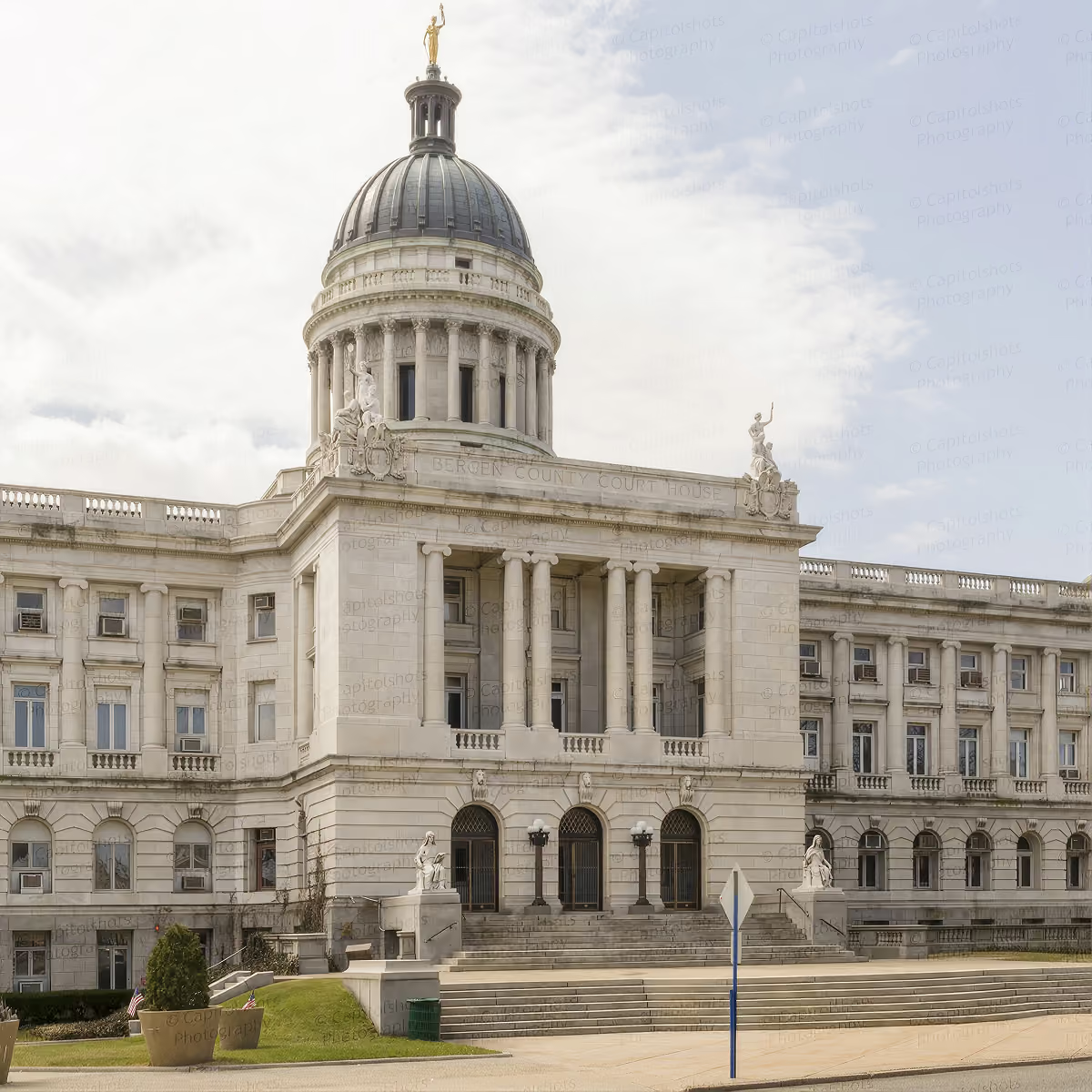
If you were hurt in Hackensack, James Vasquez fights to get you every dollar you are owed. He has represented Bergen County's injured since 2004, and he knows this county seat's I-80, Route 4 and Route 17 corridors, its historic Hackensack River bridges, and the streets around Main Street and Hackensack University Medical Center.
.avif)
Was the driver medically permitted to be behind the wheel
.avif)
.svg)
Truck cases are usually investigated as events. What happened in the seconds before impact, what the logs said, what the equipment was doing. There is an earlier question that almost nobody asks, and the answer sits in a file the carrier already holds.
Federal rules require a person to be medically certified as physically qualified before operating a commercial motor vehicle. That certification comes from an examiner working to defined standards, covering vision and hearing, cardiovascular and neurological conditions, diabetes management, and anything else bearing on the ability to control a heavy vehicle safely. A certificate has an expiry, and where a condition needs monitoring it may be issued for a shorter period than the maximum. That framework depends heavily on what the driver reports. A person whose livelihood requires certification has an obvious incentive to understate a condition, and examiners generally cannot see what they are not told. Untreated sleep apnoea is the most familiar example, because its consequence is precisely the impairment that matters most at the wheel of eighty thousand pounds. So there are two questions worth asking in any serious truck case. Was the certification current and properly based, and did the carrier know or have reason to know of something that should have kept this driver off the road. Both are answered from documents. James Vasquez has handled New Jersey injury claims since 2004.
Plainfield truck crash claims we take on
Grouped by mechanism, because it determines which records answer the question.

Where Plainfield truck crashes happen
A city with through routes on its edges and delivery traffic throughout, which produces two very different kinds of collision.
Highway shoulders and breakdown areas
Drivers changing tyres, waiting for recovery, or working roadside, struck by vehicles that never moved over or slowed.
What decides it: New Jersey requires approaching traffic to move over or reduce speed for stopped vehicles displaying warning signals. It is a specific obligation.

Industrial and warehouse edges
Heavy vehicles turning from facilities onto roads carrying local traffic at speed, frequently across multiple lanes.
What decides it: sight distance and the turning movement itself, plus whether the facility's layout forced an unsafe manoeuvre onto a public street.
Rail crossings and bridge approaches
Low clearances and queueing at crossings, where a stopped or reversing commercial vehicle creates a hazard for everything behind it.
What decides it: route planning. A vehicle that should never have been routed there points at dispatch rather than at the driver alone.

The Route 22 corridor
Heavy commercial volume with sudden slowdowns at signals and jughandles, where a driver who does not react in time has nowhere to go.
What decides it: whether any braking occurred at all. Engine data and the absence of skid evidence speak directly to alertness.
Front Street and Park Avenue
Commercial vehicles serving frontage with no loading provision, manoeuvring and reversing among pedestrians and parked cars.
What decides it: the operator's own procedures on backing and spotters, which are written down and discoverable.
Residential delivery streets
Vehicles too large for the streets they are servicing, with sight lines of a few metres and children present.
What decides it: whether the vehicle was permitted on that street at all, since municipalities designate truck routes and post restrictions.
In each of these the carrier's own records answer more than the scene does, and they are produced only on demand.
Six things a driver's medical file establishes
Federal rules require medical certification before a person may operate a commercial vehicle. The paperwork behind it is obtainable and it is rarely examined.
Certification is mandatory
A person must be medically certified as physically qualified before operating a commercial motor vehicle, following examination against defined federal standards.
It expires
Certificates are issued for limited periods, and where a condition requires monitoring an examiner may certify for a shorter interval than the maximum.
The standards are specific
Vision, hearing, cardiovascular and neurological conditions, diabetes management and other matters bearing directly on the ability to control a heavy vehicle.
It depends on disclosure
An examiner generally sees what the driver reports. Someone whose income depends on certification has an obvious reason to understate a condition.
Sleep apnoea is the recurring one
Untreated, it produces exactly the impairment that matters most at the wheel. Whether it was screened for, diagnosed or treated is documented somewhere.
The carrier has duties too
Where a company knew or should have known that a driver was not fit to be driving, that is a claim against the company itself rather than only against the driver.
None of this is visible at a crash scene, and none of it is volunteered. It comes from the driver qualification and medical file held by the carrier, requested in writing before retention periods run. For how trucking claims work statewide, see the truck accident practice area page.
Compliant hours do not mean an alert driver
Logs establish whether rules were followed. They say nothing about whether the person behind the wheel was actually fit to be there, and defence teams rely on that gap.

Legal hours can still produce an exhausted driver
A driver may be entirely within permitted driving and on duty limits while having slept badly, slept in a moving vehicle, or worked a schedule that inverted their sleep pattern. Compliance with hours of service is a floor rather than proof of alertness, and a carrier that treats the maximum as a target is making a choice about risk.
The schedule may not have been achievable lawfully
Where a dispatch assignment could not have been completed within permitted hours at lawful speeds, that is evidence about the operation rather than about one driver's judgment. Dispatch records, delivery windows and route distances establish it, and the arithmetic is straightforward once the documents are in hand.
Fatigue leaves a physical signature
No braking before impact, no steering correction, drift rather than a sudden manoeuvre, and a crash in the small hours. Engine data, the absence of avoidance evidence and forward facing camera footage together build a picture that a logbook alone never shows.
Three rules about drivers rather than vehicles
The equipment and logging rules matter too. These concern whether this person should have been driving at all.
Medical qualification is a precondition
A person must not operate a commercial motor vehicle unless medically certified as physically qualified, following examination against federal standards covering vision, hearing, cardiovascular, neurological and metabolic conditions among others. Certification is time limited and the requirements were amended in 2025, so confirm the current position.
Post crash testing has tight windows
Federal rules require alcohol and controlled substance testing after qualifying crashes, within defined periods measured in hours. Whether testing was carried out, and how promptly, is itself evidence, and a missing or late test is a fact to establish rather than an absence to move past.
The move over requirement
New Jersey requires approaching drivers to move over where possible, and otherwise to reduce speed, for stopped emergency, tow and highway service vehicles displaying warning signals. Where someone is struck while stopped on a shoulder, this obligation is directly relevant.
Hours of service and electronic logging, equipment and cargo requirements, and evidence preservation are covered on the truck accident practice area page and the Plainfield personal injury page.
What to demand, and when
The medical and dispatch material is the least requested and among the most useful.
Send the preservation demand immediately
Naming the driver qualification file, the medical examiner's certificate and examination report, dispatch records, logging data and any camera footage.
Ask specifically for the medical file
Standard demands stop at logs and maintenance. The qualification and medical material is where the question of fitness to drive is answered.
Establish whether post crash testing occurred
Required within tight windows after qualifying crashes. Whether it happened, and when, should be pinned down early rather than assumed.
Get the dispatch assignment and route
Delivery windows and distances establish whether the schedule was achievable within permitted hours at lawful speeds.
Identify the operating carrier properly
The name on the trailer is frequently not the company holding the authority, the insurance and the records.

.avif)

James Vasquez
Before James Vasquez ever represented an injured person, he sat on the other side of the table. As a former prosecutor and insurance-defense attorney, he spent years learning exactly how these cases are won and lost.
Now he uses it for you. When adjusters and opposing counsel face James, they're facing someone who has read their playbook, argued in their courtrooms, and knows precisely where their arguments break.
Based in Clifton and serving Passaic, Morris, and Essex Counties, his firm gives every client James's personal attention, backed by a team that knows your file cold.
Answers, before you even call.
Anything else you’d like to know? Get in touch with our sales team and we’d be happy to discuss your questions.


Hear Our Clients’ Stories

James Vasquez was the first name everyone recommended. People told me he would make sure I was taken care of, and they were right. The team was friendly, professional, down to earth, and experienced. They handled everything, and all I had to do was listen, follow their guidance, and focus on my recovery. One of the best parts of the experience was working with the paralegal, John Velazquez. Whenever I had questions, he would stop what he was doing, sit down with me, and explain everything in detail. I never felt rushed, and I always felt that my concerns were fully answered. He helped me understand every step of the legal process, and I truly felt like I had a friend inside the firm."
Kraig Moultrie


Hear Our Clients’ Stories
After the accident at work, my health and my ability to work changed dramatically. I faced many challenges because I could no longer do the same things I used to do. Before receiving help, I was afraid because my health wasn't improving, and I didn't know what to do. The insurance company made things difficult, asking me questions I didn't know how to answer, and I felt lost and overwhelmed. Then I found this team, and from the very first conversation they gave me confidence and explained everything clearly. They guided me through the entire treatment process, helped me access the medical care I needed, and supported me every step of the way."
Martina Contreras

What it's actually like to work with us
We'll skip the sales pitch. This is what it's actually like to have James in your corner; straight from the people who've been there.

"Staff is very Friendly. They keep you informed on a regular basis. The Attorneys are the best. Would recommend this Law firm to anyone."


"James Vasquez is one of the best Lawyers. He knows what he's doing at all times, very Professional along with his staffs that entire office has very good attitude. He keeps you updated and gives good advise he did very good with my case and I highly recommend him. He deserves more than five stars!"
"James Vasquez and his team took care of my case like if it was their own. I was able to take care of my car accident case, and even during this pandemic. I never felt pressured, and they were definitely patient with my case."
"Throughout this process, James and I kept in touch via email, and he offered his guidance every step of the way."
"I would highly recommend anyone to hire him!"
"Mr. Vasquez was able to recover a good settlement for me and he recommended me to great medical professionals to help with my back and neck injuries."
James Vasquez was the first name everyone recommended. People told me he would make sure I was taken care of, and they were right. The team was friendly, professional, down to earth, and experienced. They handled everything, and all I had to do was listen, follow their guidance, and focus on my recovery. One of the best parts of the experience was working with the paralegal, John Velazquez. Whenever I had questions, he would stop what he was doing, sit down with me, and explain everything in detail. I never felt rushed, and I always felt that my concerns were fully answered. He helped me understand every step of the legal process, and I truly felt like I had a friend inside the firm."
After the accident at work, my health and my ability to work changed dramatically. I faced many challenges because I could no longer do the same things I used to do. Before receiving help, I was afraid because my health wasn't improving, and I didn't know what to do. The insurance company made things difficult, asking me questions I didn't know how to answer, and I felt lost and overwhelmed. Then I found this team, and from the very first conversation they gave me confidence and explained everything clearly. They guided me through the entire treatment process, helped me access the medical care I needed, and supported me every step of the way."
"Staff is very Friendly. They keep you informed on a regular basis. The Attorneys are the best. Would recommend this Law firm to anyone."
"James Vasquez is one of the best Lawyers. He knows what he's doing at all times, very Professional along with his staffs that entire office has very good attitude. He keeps you updated and gives good advise he did very good with my case and I highly recommend him. He deserves more than five stars!"
"James Vasquez and his team took care of my case like if it was their own. I was able to take care of my car accident case, and even during this pandemic. I never felt pressured, and they were definitely patient with my case."
"Throughout this process, James and I kept in touch via email, and he offered his guidance every step of the way."
"I would highly recommend anyone to hire him!"
"Mr. Vasquez was able to recover a good settlement for me and he recommended me to great medical professionals to help with my back and neck injuries."
James Vasquez was the first name everyone recommended. People told me he would make sure I was taken care of, and they were right. The team was friendly, professional, down to earth, and experienced. They handled everything, and all I had to do was listen, follow their guidance, and focus on my recovery. One of the best parts of the experience was working with the paralegal, John Velazquez. Whenever I had questions, he would stop what he was doing, sit down with me, and explain everything in detail. I never felt rushed, and I always felt that my concerns were fully answered. He helped me understand every step of the legal process, and I truly felt like I had a friend inside the firm."
After the accident at work, my health and my ability to work changed dramatically. I faced many challenges because I could no longer do the same things I used to do. Before receiving help, I was afraid because my health wasn't improving, and I didn't know what to do. The insurance company made things difficult, asking me questions I didn't know how to answer, and I felt lost and overwhelmed. Then I found this team, and from the very first conversation they gave me confidence and explained everything clearly. They guided me through the entire treatment process, helped me access the medical care I needed, and supported me every step of the way."
Some of it is public. The rest requires a demand, quickly.
Publishes carrier safety records including inspection results, violation history and crash records, searchable by the identification number displayed on the vehicle.
Holds the qualification and medical material, including the examiner's certificate and examination report, employment history and prior violations. Produced only under demand.
Holds the crash report and, for serious commercial collisions, any reconstruction or post crash inspection materials.
Holds the assignment, the delivery window and the route, which together establish whether the schedule was achievable lawfully.
Hurt in New Jersey? Let's Talk.
James Vasquez gives injured people across New Jersey a free, no obligation case review. Tell us what happened and we'll walk you through your options and what your claim may be worth.
.png)
Reach us whatever way works for you.
Need to talk to someone right now?

Areas we serve


.jpg)