Orange Catastrophic Injury Lawyer Essex County, New Jersey
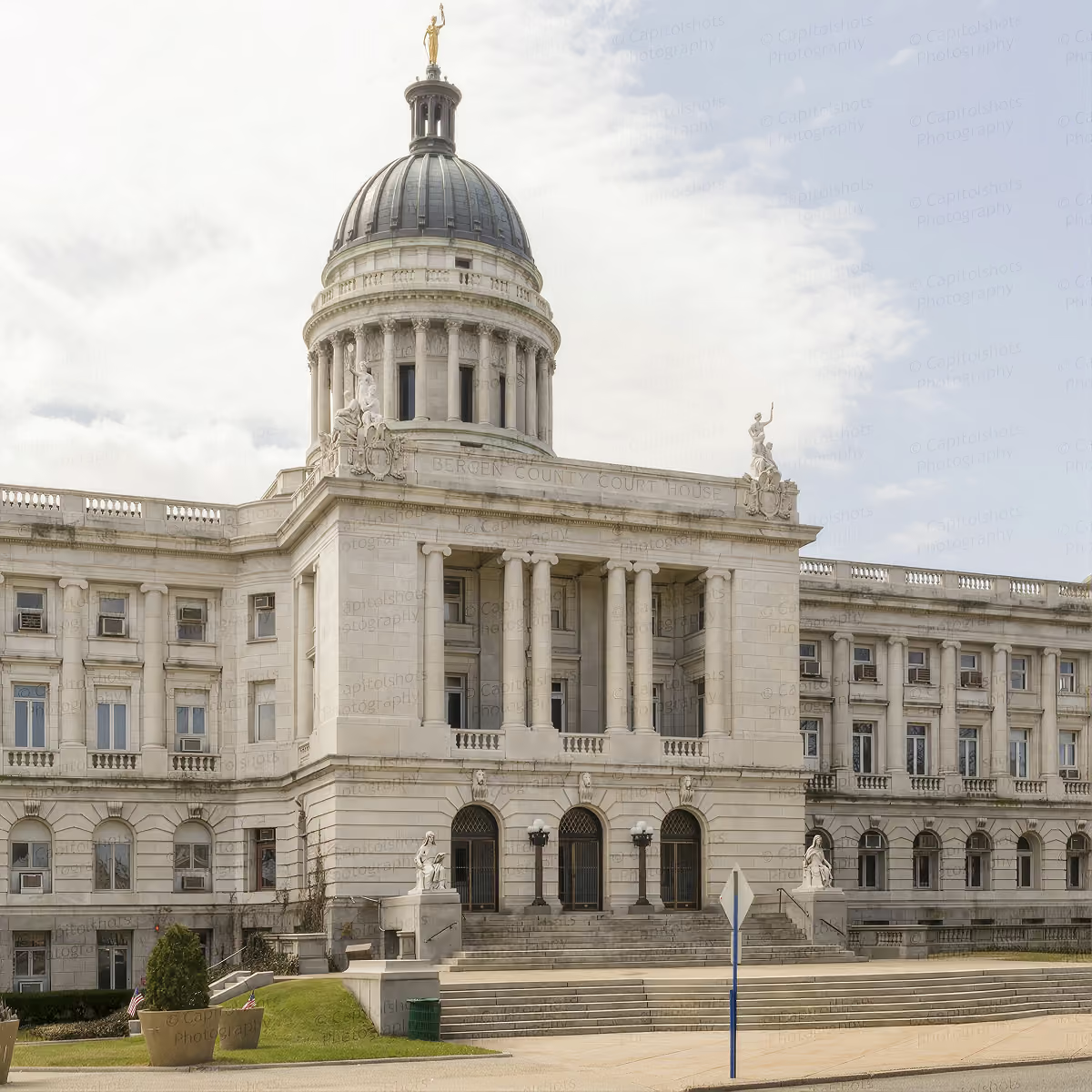
If you were hurt in Hackensack, James Vasquez fights to get you every dollar you are owed. He has represented Bergen County's injured since 2004, and he knows this county seat's I-80, Route 4 and Route 17 corridors, its historic Hackensack River bridges, and the streets around Main Street and Hackensack University Medical Center.
.avif)
Winning and collecting are different questions
.avif)
.svg)
Families reasonably assume that establishing responsibility is the hard part. In a catastrophic case with more than one defendant, the harder part is frequently what happens after the percentages are assigned.
New Jersey requires a jury to make two findings. The full value of the injured person's damages, and the percentage of fault attributable to each party, totalling one hundred percent. The judge then moulds the judgment to those findings. If your own share of fault exceeds half, you recover nothing at all. Below that, your award is reduced by your percentage. Then comes the rule that decides collectability. A defendant found sixty percent or more at fault is liable for the whole award, so you can look to that one party for everything. A defendant below sixty percent is responsible only for their own percentage. In a case where one defendant is well insured and another is insolvent, the difference between fifty five and sixty percent can be the difference between a funded lifetime of care and a paper judgment. There is a further wrinkle that surprises people. Fault can be allocated to parties who cannot pay anything, including defendants who are insolvent, immune, or never identified, and juries are directed to allocate based on the evidence rather than on who can pay. James Vasquez has handled New Jersey injury claims since 2004.
Catastrophic injuries we handle in Orange
The allocation question arises most sharply where several parties contributed.

How allocation plays out in practice
Six situations where the percentages, rather than the liability, decide the outcome.
A contractor that has since folded
Common in construction cases, where a subcontractor whose conduct was central no longer exists or has no meaningful assets.
What it means: fault can still be allocated to them, and juries are directed to allocate on the evidence rather than on who can pay.

The employer in a workplace case
Workers compensation generally bars a claim against the employer, while the employer's conduct may still have contributed to what happened.
What it means: how that interacts with allocation among the remaining defendants is technical, fact specific, and worth addressing at the outset.
Settling with one defendant
Resolving with one party before trial has consequences for what can be recovered from the others, and for how their shares are calculated.
What it means: the sequence and structure of any partial settlement should be planned rather than taken as it comes.

One solvent defendant among several
Where a well insured party and a poorly insured one both contributed, everything turns on whether the solvent defendant crosses the threshold.
What it means: at sixty percent or above, they answer for the whole award. Below it, only their share, and the rest may be uncollectable.
An unidentified driver
Where another vehicle contributed and was never traced. New Jersey permits a jury to apportion fault to a known but unidentified defendant.
What it means: that share comes off the recoverable total unless other coverage responds, which is where uninsured motorist protection becomes central.
Your own share
Any percentage attributed to the injured person reduces the award, and a share exceeding half defeats the claim entirely.
What it means: in a catastrophic case the defence invests heavily here, because a few percentage points are worth a great deal.
None of this is visible from the merits of a case. It is arithmetic applied afterwards, and it decides what a family actually receives.
Six rules that decide what you collect
These apply to every negligence case in New Jersey and they matter most where the damages are largest.
The jury finds full value first
The award is determined without regard to fault, as the full value of the injured party's damages. Apportionment happens afterwards.
Percentages total one hundred
Each party's share of fault is expressed as a percentage, and all of them together must add to one hundred percent.
Above half and you recover nothing
An injured person whose own share of fault exceeds fifty percent is barred entirely. At or below it, the award is reduced by that percentage.
Sixty percent is the collectability line
A defendant found sixty percent or more at fault can be required to pay the entire award. Below sixty percent, they pay only their own share.
Fault goes to parties who cannot pay
Allocation is based on the evidence rather than on collectability, so shares can land on insolvent, immune or unidentified parties.
Contribution runs between defendants
A defendant who pays more than their share can seek contribution from the others. That is their problem rather than yours, which is the point of the rule.
If more than one party contributed to your injury, the allocation strategy should be part of the case from the beginning rather than an issue that arrives at trial. For how these claims work statewide, see the catastrophic injury practice area page.
Three ways a large award becomes a small recovery
Each of these is avoidable to some degree, and each is invisible until it happens.

The share that lands on someone who cannot pay
Juries are directed to allocate fault on the evidence, not on whether a party can satisfy a judgment. So a defunct contractor, an unidentified driver or a party protected by immunity can be assigned a substantial percentage, and unless another defendant crosses the sixty percent threshold or separate coverage responds, that portion is simply not collectable. Identifying every solvent party early, and building the evidence that places responsibility with them, is the practical answer.
A defendant who lands just below the threshold
The difference between a defendant at fifty five percent and one at sixty is the difference between recovering their share and recovering everything. In a catastrophic case that gap can be worth millions, which is why the evidence supporting each party's degree of responsibility deserves the same attention as the evidence of liability itself.
Your own percentage
Every point attributed to the injured person comes off the award, and above fifty percent the claim fails entirely. In serious cases the defence invests heavily in this, because the return on a few percentage points is enormous. Seatbelt use, safety equipment and conduct at the scene all get examined, and each is answerable with evidence rather than argument.
Three rules of New Jersey's allocation framework
Technical, and directly determinative of what a family receives.
The sixty percent threshold
A party found sixty percent or more responsible for the total damages may be required to pay the full amount, leaving them to seek contribution from the others. A party found less than sixty percent responsible is liable only for the percentage attributable to them. In a multi defendant catastrophic case this single provision frequently decides what is collectable.
What the jury must decide
The trier of fact determines the full value of the injured party's damages without regard to fault, and then the percentage of each party's negligence, with all percentages totalling one hundred. The judge moulds the judgment to those findings.
The bar at more than half
An injured person may not recover where their own negligence is greater than that of the party or parties against whom recovery is sought. Where recovery is permitted, damages are reduced by the percentage of fault attributed to them.
The absence of a cap on compensatory damages, lifetime cost projection, guardianship where capacity is affected and court approval of settlements are covered on the catastrophic injury practice area page and the Orange personal injury page.
What protects the allocation position
Most of it happens early, long before percentages are argued.
Identify every responsible party immediately
Including ones who look peripheral. A party left out cannot be pursued, and their share may still be allocated to them at trial.
Establish who is solvent and insured
Coverage and asset position do not affect the jury's allocation, and they determine entirely what a favourable allocation is worth.
Preserve the evidence that assigns responsibility
Documents, equipment and footage that establish degree rather than merely existence of fault. This is what moves a defendant above or below the threshold.
Address your own conduct honestly
Seatbelt use, safety equipment, what you did at the scene. Every point matters, and preparation beats explanation.
Plan any partial settlement
Resolving with one defendant affects what can be recovered from the others. It should be structured deliberately rather than accepted when offered.

.avif)

James Vasquez
Before James Vasquez ever represented an injured person, he sat on the other side of the table. As a former prosecutor and insurance-defense attorney, he spent years learning exactly how these cases are won and lost.
Now he uses it for you. When adjusters and opposing counsel face James, they're facing someone who has read their playbook, argued in their courtrooms, and knows precisely where their arguments break.
Based in Clifton and serving Passaic, Morris, and Essex Counties, his firm gives every client James's personal attention, backed by a team that knows your file cold.
Answers, before you even call.
Anything else you’d like to know? Get in touch with our sales team and we’d be happy to discuss your questions.


Hear Our Clients’ Stories

James Vasquez was the first name everyone recommended. People told me he would make sure I was taken care of, and they were right. The team was friendly, professional, down to earth, and experienced. They handled everything, and all I had to do was listen, follow their guidance, and focus on my recovery. One of the best parts of the experience was working with the paralegal, John Velazquez. Whenever I had questions, he would stop what he was doing, sit down with me, and explain everything in detail. I never felt rushed, and I always felt that my concerns were fully answered. He helped me understand every step of the legal process, and I truly felt like I had a friend inside the firm."
Kraig Moultrie


Hear Our Clients’ Stories
After the accident at work, my health and my ability to work changed dramatically. I faced many challenges because I could no longer do the same things I used to do. Before receiving help, I was afraid because my health wasn't improving, and I didn't know what to do. The insurance company made things difficult, asking me questions I didn't know how to answer, and I felt lost and overwhelmed. Then I found this team, and from the very first conversation they gave me confidence and explained everything clearly. They guided me through the entire treatment process, helped me access the medical care I needed, and supported me every step of the way."
Martina Contreras

What it's actually like to work with us
We'll skip the sales pitch. This is what it's actually like to have James in your corner; straight from the people who've been there.

"Staff is very Friendly. They keep you informed on a regular basis. The Attorneys are the best. Would recommend this Law firm to anyone."


"James Vasquez is one of the best Lawyers. He knows what he's doing at all times, very Professional along with his staffs that entire office has very good attitude. He keeps you updated and gives good advise he did very good with my case and I highly recommend him. He deserves more than five stars!"
"James Vasquez and his team took care of my case like if it was their own. I was able to take care of my car accident case, and even during this pandemic. I never felt pressured, and they were definitely patient with my case."
"Throughout this process, James and I kept in touch via email, and he offered his guidance every step of the way."
"I would highly recommend anyone to hire him!"
"Mr. Vasquez was able to recover a good settlement for me and he recommended me to great medical professionals to help with my back and neck injuries."
James Vasquez was the first name everyone recommended. People told me he would make sure I was taken care of, and they were right. The team was friendly, professional, down to earth, and experienced. They handled everything, and all I had to do was listen, follow their guidance, and focus on my recovery. One of the best parts of the experience was working with the paralegal, John Velazquez. Whenever I had questions, he would stop what he was doing, sit down with me, and explain everything in detail. I never felt rushed, and I always felt that my concerns were fully answered. He helped me understand every step of the legal process, and I truly felt like I had a friend inside the firm."
After the accident at work, my health and my ability to work changed dramatically. I faced many challenges because I could no longer do the same things I used to do. Before receiving help, I was afraid because my health wasn't improving, and I didn't know what to do. The insurance company made things difficult, asking me questions I didn't know how to answer, and I felt lost and overwhelmed. Then I found this team, and from the very first conversation they gave me confidence and explained everything clearly. They guided me through the entire treatment process, helped me access the medical care I needed, and supported me every step of the way."
"Staff is very Friendly. They keep you informed on a regular basis. The Attorneys are the best. Would recommend this Law firm to anyone."
"James Vasquez is one of the best Lawyers. He knows what he's doing at all times, very Professional along with his staffs that entire office has very good attitude. He keeps you updated and gives good advise he did very good with my case and I highly recommend him. He deserves more than five stars!"
"James Vasquez and his team took care of my case like if it was their own. I was able to take care of my car accident case, and even during this pandemic. I never felt pressured, and they were definitely patient with my case."
"Throughout this process, James and I kept in touch via email, and he offered his guidance every step of the way."
"I would highly recommend anyone to hire him!"
"Mr. Vasquez was able to recover a good settlement for me and he recommended me to great medical professionals to help with my back and neck injuries."
James Vasquez was the first name everyone recommended. People told me he would make sure I was taken care of, and they were right. The team was friendly, professional, down to earth, and experienced. They handled everything, and all I had to do was listen, follow their guidance, and focus on my recovery. One of the best parts of the experience was working with the paralegal, John Velazquez. Whenever I had questions, he would stop what he was doing, sit down with me, and explain everything in detail. I never felt rushed, and I always felt that my concerns were fully answered. He helped me understand every step of the legal process, and I truly felt like I had a friend inside the firm."
After the accident at work, my health and my ability to work changed dramatically. I faced many challenges because I could no longer do the same things I used to do. Before receiving help, I was afraid because my health wasn't improving, and I didn't know what to do. The insurance company made things difficult, asking me questions I didn't know how to answer, and I felt lost and overwhelmed. Then I found this team, and from the very first conversation they gave me confidence and explained everything clearly. They guided me through the entire treatment process, helped me access the medical care I needed, and supported me every step of the way."
Practical rather than legal, and worth knowing early.
Hospital case managers coordinate the transition out of acute care, and their assessments document need while it is happening.
Administers needs based and contribution based disability programs. Which applies matters, because only the needs based ones are affected by a settlement.
A starting point for state programs, equipment funding and community support available to residents.
Uninsured and underinsured motorist coverage matters enormously where a share of fault lands on a party who cannot pay.
Hurt in New Jersey? Let's Talk.
James Vasquez gives injured people across New Jersey a free, no obligation case review. Tell us what happened and we'll walk you through your options and what your claim may be worth.
.png)
Reach us whatever way works for you.
Need to talk to someone right now?

Areas we serve


.jpg)