Lodi Truck Accident Lawyer Bergen County, New Jersey
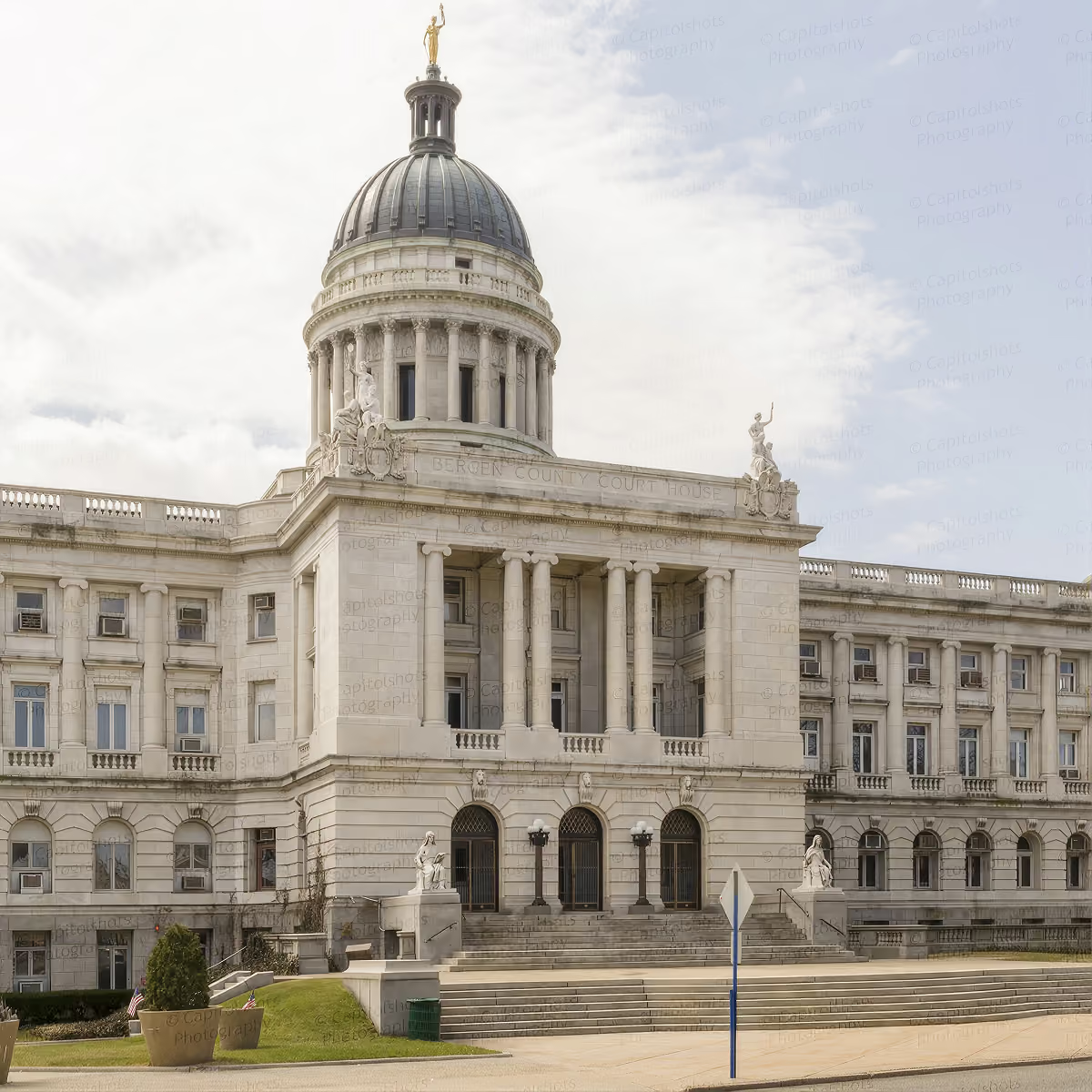
If you were hurt in Hackensack, James Vasquez fights to get you every dollar you are owed. He has represented Bergen County's injured since 2004, and he knows this county seat's I-80, Route 4 and Route 17 corridors, its historic Hackensack River bridges, and the streets around Main Street and Hackensack University Medical Center.
.avif)
There are rules about which roads trucks may use
.avif)
.svg)
In a dense borough with a highway through the middle of it, the question after a collision is frequently not how the truck was driven but why it was on that street at all.
New Jersey sets out a hierarchy of roads for large trucks. The National Network first, then the state access network, then local unrestricted roads, then roads designated with limited accessibility. Large trucks must complete trips using the National Network and may leave it only to reach a terminal or facilities for food, fuel, repairs or rest, and then by the direct route, meaning the shortest travel distance, returning to the network as soon as practicable. Detours off the authorised routes are permitted only to the extent necessary to bypass road closings and restrictions such as weight or clearance limits. One provision matters more than the rest here. The code states that to the extent feasible, a trip to a terminal or to facilities for food, fuel, repairs and rest shall avoid residential areas. That is a written standard, and a truck cutting through a residential grid because an application told it to is not obviously meeting it. Municipalities can go further. The state rules expressly do not supersede municipal ordinances and county resolutions restricting the through movement of trucks, including maximum weight postings and locally designated truck routes. Where those are posted in conformity with the recognised standards at points of entry and exit, that posting is treated as notice to operators. James Vasquez has handled New Jersey injury claims since 2004.
Commercial vehicle claims we handle in Bergen County
Where the truck was allowed to be is a question with a documented answer.

Where Lodi truck collisions happen
A dense borough carrying a highway and the traffic that comes off it.
Main Street and Passaic Avenue
Streets carrying traffic between the highway and the neighbourhoods, with turning movements into frontage and constant stopping.
What to establish: whether a delivery on that street justified the trip, because access to a terminal must be by the shortest route.

The Saddle River crossings
Bridge approaches where posted limits apply and where a vehicle exceeding them should not have been routed at all.
What to establish: the posting itself. Signage placed in conformity with recognised standards at points of entry is treated as notice to operators.
Around Felician University
Students and staff on foot in an area also used by delivery traffic, where a large vehicle's blind spots are at their most dangerous.
What to establish: whether the vehicle had any legitimate reason to be on that street at that hour.

Route 46
The corridor carrying regional traffic across the borough, with retail entrances and queueing that produces rear end and chain reaction collisions at speed.
What to establish: whether the vehicle was on the network legitimately, and what the carrier's own routing instructions said.
The residential grid
Narrow streets parked on both sides where a large vehicle cannot turn without crossing the opposing lane or mounting a kerb.
What to establish: the code states that trips to terminals and facilities shall avoid residential areas to the extent feasible. That is a standard, not a courtesy.
The Garfield and Saddle Brook borders
Streets crossing municipal lines where restrictions differ on either side and the responding department may not be the one you expect.
What to establish: which municipality's ordinance applied, since state rules expressly do not supersede local restrictions.
In each of these the routing records sit with the carrier and are produced only under demand.
Four requirements a truck has to meet
Confirm current provisions, because the truck access rules were amended in 2023.
Stay on the network
Large trucks must complete trips using the National Network and may leave it only to reach a terminal or facilities for food, fuel, repairs or rest.
Take the direct route
A trip off the network must be by the shortest travel distance, and the vehicle must return to the designated network as soon as practicable.
Avoid residential areas
The code states that to the extent feasible, a trip to a terminal or to facilities for food, fuel, repairs and rest shall avoid residential areas.
Local restrictions still apply
State rules do not supersede municipal ordinances or county resolutions restricting through movement, including posted weight limits and designated local truck routes.
None of this decides fault for a collision by itself. It establishes whether a vehicle should have been where it was, which is a different and frequently more useful question. For how trucking claims work statewide, see the truck accident practice area page.
Two things that put trucks on the wrong streets
One is a technology failure and one is a management failure, and the second is the claim.

Consumer applications do not filter truck restrictions
Commercial routing software accounts for weight limits, clearance restrictions and local truck prohibitions. General purpose navigation applications are not built to do that reliably, and industry guidance is explicit that drivers should use commercial routing tools rather than consumer apps in this state. A driver following a phone onto a residential street is following something that was never designed to know the street was restricted, and that is a foreseeable and well documented problem rather than an unlucky one.
Routing is the carrier's responsibility
Which tool a driver uses, what routing instructions they are given, and whether the company checked the route against restrictions before dispatch are decisions made by the business rather than by the person at the wheel. Where a carrier left routing to a driver with a consumer application and no guidance, that is a claim about how the company operates, proved from dispatch records, routing instructions and its own written procedures. It sits alongside any claim against the driver rather than replacing it.
Three rules about where trucks may travel
Confirm the current code, which was amended effective January 2023.
The network hierarchy and residential areas
Large trucks must complete trips using the National Network and may leave it only for terminal access or for food, fuel, repairs and rest, by the direct route, returning as soon as practicable. The code states that to the extent feasible such trips shall avoid residential areas, and permits detours only to the extent necessary to bypass closures and restrictions.
Local ordinances are not superseded
The state rules expressly do not supersede other State rules, municipal ordinances and county resolutions restricting or controlling the through movement of trucks, giving maximum weight postings and locally designated truck routes as examples. Where signage is posted in conformity with recognised standards at points of entry and exit, that is treated as notice to operators.
The carrier's own decisions
Separately from the driver's conduct, a company is responsible for how it routes and dispatches. Whether the route was checked against restrictions, what tools the driver was given and what instructions accompanied the load are established from the carrier's own records.
Hours of service, driver qualification, maintenance requirements and evidence preservation are covered on the truck accident practice area page and the Lodi personal injury page.
What to establish early
Where the truck was allowed to be is answerable from documents.
Photograph the street and any signage
Posted weight limits and truck route designations at the entry points, which establish what applied and what the driver was on notice of.
Demand the routing and dispatch records
The planned route, the instructions given and the tools the driver was expected to use. These sit with the carrier and are produced under demand.
Establish whether a delivery justified the trip
Access to a terminal is permitted by the shortest route. A truck on a residential street with no local destination is in a different position.
Identify the operating carrier correctly
The name on the trailer is frequently not the entity holding the authority, the insurance and the routing records.

.avif)

James Vasquez
Before James Vasquez ever represented an injured person, he sat on the other side of the table. As a former prosecutor and insurance-defense attorney, he spent years learning exactly how these cases are won and lost.
Now he uses it for you. When adjusters and opposing counsel face James, they're facing someone who has read their playbook, argued in their courtrooms, and knows precisely where their arguments break.
Based in Clifton and serving Passaic, Morris, and Essex Counties, his firm gives every client James's personal attention, backed by a team that knows your file cold.
Answers, before you even call.
Anything else you’d like to know? Get in touch with our sales team and we’d be happy to discuss your questions.


Hear Our Clients’ Stories

James Vasquez was the first name everyone recommended. People told me he would make sure I was taken care of, and they were right. The team was friendly, professional, down to earth, and experienced. They handled everything, and all I had to do was listen, follow their guidance, and focus on my recovery. One of the best parts of the experience was working with the paralegal, John Velazquez. Whenever I had questions, he would stop what he was doing, sit down with me, and explain everything in detail. I never felt rushed, and I always felt that my concerns were fully answered. He helped me understand every step of the legal process, and I truly felt like I had a friend inside the firm."
Kraig Moultrie


Hear Our Clients’ Stories
After the accident at work, my health and my ability to work changed dramatically. I faced many challenges because I could no longer do the same things I used to do. Before receiving help, I was afraid because my health wasn't improving, and I didn't know what to do. The insurance company made things difficult, asking me questions I didn't know how to answer, and I felt lost and overwhelmed. Then I found this team, and from the very first conversation they gave me confidence and explained everything clearly. They guided me through the entire treatment process, helped me access the medical care I needed, and supported me every step of the way."
Martina Contreras

What it's actually like to work with us
We'll skip the sales pitch. This is what it's actually like to have James in your corner; straight from the people who've been there.

"Staff is very Friendly. They keep you informed on a regular basis. The Attorneys are the best. Would recommend this Law firm to anyone."


"James Vasquez is one of the best Lawyers. He knows what he's doing at all times, very Professional along with his staffs that entire office has very good attitude. He keeps you updated and gives good advise he did very good with my case and I highly recommend him. He deserves more than five stars!"
"James Vasquez and his team took care of my case like if it was their own. I was able to take care of my car accident case, and even during this pandemic. I never felt pressured, and they were definitely patient with my case."
"Throughout this process, James and I kept in touch via email, and he offered his guidance every step of the way."
"I would highly recommend anyone to hire him!"
"Mr. Vasquez was able to recover a good settlement for me and he recommended me to great medical professionals to help with my back and neck injuries."
James Vasquez was the first name everyone recommended. People told me he would make sure I was taken care of, and they were right. The team was friendly, professional, down to earth, and experienced. They handled everything, and all I had to do was listen, follow their guidance, and focus on my recovery. One of the best parts of the experience was working with the paralegal, John Velazquez. Whenever I had questions, he would stop what he was doing, sit down with me, and explain everything in detail. I never felt rushed, and I always felt that my concerns were fully answered. He helped me understand every step of the legal process, and I truly felt like I had a friend inside the firm."
After the accident at work, my health and my ability to work changed dramatically. I faced many challenges because I could no longer do the same things I used to do. Before receiving help, I was afraid because my health wasn't improving, and I didn't know what to do. The insurance company made things difficult, asking me questions I didn't know how to answer, and I felt lost and overwhelmed. Then I found this team, and from the very first conversation they gave me confidence and explained everything clearly. They guided me through the entire treatment process, helped me access the medical care I needed, and supported me every step of the way."
"Staff is very Friendly. They keep you informed on a regular basis. The Attorneys are the best. Would recommend this Law firm to anyone."
"James Vasquez is one of the best Lawyers. He knows what he's doing at all times, very Professional along with his staffs that entire office has very good attitude. He keeps you updated and gives good advise he did very good with my case and I highly recommend him. He deserves more than five stars!"
"James Vasquez and his team took care of my case like if it was their own. I was able to take care of my car accident case, and even during this pandemic. I never felt pressured, and they were definitely patient with my case."
"Throughout this process, James and I kept in touch via email, and he offered his guidance every step of the way."
"I would highly recommend anyone to hire him!"
"Mr. Vasquez was able to recover a good settlement for me and he recommended me to great medical professionals to help with my back and neck injuries."
James Vasquez was the first name everyone recommended. People told me he would make sure I was taken care of, and they were right. The team was friendly, professional, down to earth, and experienced. They handled everything, and all I had to do was listen, follow their guidance, and focus on my recovery. One of the best parts of the experience was working with the paralegal, John Velazquez. Whenever I had questions, he would stop what he was doing, sit down with me, and explain everything in detail. I never felt rushed, and I always felt that my concerns were fully answered. He helped me understand every step of the legal process, and I truly felt like I had a friend inside the firm."
After the accident at work, my health and my ability to work changed dramatically. I faced many challenges because I could no longer do the same things I used to do. Before receiving help, I was afraid because my health wasn't improving, and I didn't know what to do. The insurance company made things difficult, asking me questions I didn't know how to answer, and I felt lost and overwhelmed. Then I found this team, and from the very first conversation they gave me confidence and explained everything clearly. They guided me through the entire treatment process, helped me access the medical care I needed, and supported me every step of the way."
Some is posted on the street and the rest belongs to the carrier.
Holds the crash report, and enforcement records for posted truck restrictions on borough streets, which bear on whether the problem was known.
Holds the ordinances designating local truck routes and weight postings, and the records of where that signage is placed.
Publishes the large truck routing regulations and network maps establishing which roads a vehicle of that size was permitted to use.
Civil suits arising from Bergen County crashes are filed with the Civil Division at 10 Main Street in Hackensack.
Hurt in New Jersey? Let's Talk.
James Vasquez gives injured people across New Jersey a free, no obligation case review. Tell us what happened and we'll walk you through your options and what your claim may be worth.
.png)
Reach us whatever way works for you.
Need to talk to someone right now?

Areas we serve


.jpg)