Garfield Truck Accident Lawyer Bergen County, New Jersey
If you were hurt in Hackensack, James Vasquez fights to get you every dollar you are owed. He has represented Bergen County's injured since 2004, and he knows this county seat's I-80, Route 4 and Route 17 corridors, its historic Hackensack River bridges, and the streets around Main Street and Hackensack University Medical Center.
.avif)
The duty owed to people working beside traffic
.avif)
.svg)
Tow operators, recovery crews, highway maintenance workers and sanitation crews stand a few feet from moving traffic as a condition of the job. The law recognises that and imposes an obligation on everybody passing them.
New Jersey's move over law requires an operator approaching a stationary authorised emergency vehicle displaying flashing red or blue lights to proceed with due caution and either make a lane change into a lane not adjacent to it, where that is possible in the existing safety and traffic conditions, or where a lane change is impossible, prohibited or unsafe, reduce speed to a reasonable and proper speed for the conditions, which the statute specifies must be less than the posted speed limit, and be prepared to stop. The same obligations apply to a stationary tow truck displaying a flashing amber light, to a highway maintenance or emergency service vehicle operated by the State, an authority, a county or a municipality and displaying flashing yellow, amber or red lights, and to a sanitation vehicle displaying a flashing amber warning light. It is not limited to police and ambulances, which is the assumption most drivers make. For somebody struck while working, the important point is that this is a statutory duty rather than a courtesy. A failure to move over may be evidence of negligence where a first responder, tow operator, highway maintenance worker, emergency service worker or sanitation worker is injured or killed by a driver who did not comply. James Vasquez has handled New Jersey injury claims since 2004.
Commercial vehicle claims we handle in Bergen County
Roadside work produces a category of collision with its own rules.
Where Garfield roadside incidents happen
A dense city with a highway across it and river crossings on three sides.
The Passaic River crossings
Bridge approaches where there is no shoulder to work from and a disabled vehicle cannot be moved clear of traffic.
What to establish: whether a lane change was actually available, since the statute requires a reduction below the speed limit where it is not.

Outwater Lane and Passaic Street
Routes worked by sanitation crews at fixed times, with workers moving repeatedly between the vehicle and the kerb.
What to establish: the flashing amber warning light on the vehicle, which is the trigger the statute names for sanitation vehicles.
Anywhere with a single lane each way
Streets where a lane change is simply unavailable and the only compliance route is slowing well below the limit.
What to establish: that the obligation does not disappear because moving over was impossible. The statute prescribes what to do instead.

Route 46
Through traffic at highway speeds with narrow shoulders, where a recovery operation puts a person a few feet from moving vehicles.
What to establish: whether the lights were displayed and what the approaching driver did, because the duty is triggered by the flashing light rather than by the type of vehicle.
Midland Avenue and River Drive
Streets carrying steady traffic where utility crews, sanitation vehicles and tow operators work alongside moving lanes throughout the day.
What to establish: that the duty is not limited to emergency vehicles, since maintenance, utility and sanitation vehicles are expressly covered.
Palisade Avenue and the station approaches
Concentrated traffic at predictable hours, where a stopped vehicle with lights on becomes an obstruction people drive around rather than slow for.
What to establish: the speed of the passing vehicle, which the statute requires to be below the posted limit where no lane change was possible.
In each of these the lights on the stationary vehicle are the fact that engages the duty, and photographs from the scene establish them.
Four things about the move over duty
Confirm current penalties, because the provision has been amended more than once.
Flashing lights on a stationary vehicle
Red or blue on an authorised emergency vehicle, amber on a tow truck, yellow, amber or red on a maintenance or emergency service vehicle, and amber on a sanitation vehicle.
Change lanes
Into a lane not adjacent to the stationary vehicle, where that is possible in the existing safety and traffic conditions.
Slow below the limit
Where a lane change is impossible, prohibited or unsafe, reduce speed to a reasonable and proper speed for the conditions, which the statute says must be less than the posted limit, and be prepared to stop.
It is not a courtesy
It is a statutory duty. Failing it may be evidence of negligence where a roadside worker is injured or killed as a result.
The obligation covers tow trucks, maintenance vehicles and sanitation trucks as well as police and ambulances, which is the part drivers most often get wrong. For how commercial vehicle claims work statewide, see the truck accident practice area page.
Two claims usually run at once
A worker struck at the roadside is frequently entitled to pursue both.

Workers compensation, and what it does not cover
Where you were working when struck, compensation covers authorised medical treatment and partial wage replacement without any need to prove fault, and it bars suing your employer. What it does not provide is compensation for pain and suffering, and it does not touch the driver who hit you. It also creates a reimbursement interest, so what your employer's carrier paid may be repaid from any recovery against that driver. That interaction should be understood at the start rather than discovered at settlement.
The claim against the driver
This is the claim that reaches everything compensation does not, and the move over duty is central to it. Where the stationary vehicle displayed the required lights and the approaching driver neither changed lanes nor slowed below the posted limit, that is a departure from a specific statutory obligation rather than a general assertion of carelessness. Photographs, dash and body camera footage, and the accounts of colleagues on scene establish it.
Three rules about roadside work
Confirm current penalty provisions, which have been the subject of amendment.
The move over duty
An operator approaching a stationary authorised emergency vehicle displaying flashing red or blue lights must approach with due caution and change into a lane not adjacent to it where possible, or where that is impossible, prohibited or unsafe, reduce speed to a reasonable and proper speed for the conditions which shall be less than the posted speed limit, and be prepared to stop.
Beyond police and ambulances
The same obligations apply to a stationary tow truck displaying a flashing amber light, a highway maintenance or emergency service vehicle operated by the State, an authority, a county or a municipality displaying flashing yellow, amber or red lights, and a sanitation vehicle displaying a flashing amber warning light.
A fine, and something more useful
Violations carry a fine in the range of one hundred to five hundred dollars, and the position on motor vehicle points has been amended and should be confirmed. For an injured worker the more significant consequence is that a failure to move over may be evidence of negligence in a civil claim.
Workers compensation liens, the two year filing deadline and the shorter notice required where a public entity is involved are covered on the truck accident practice area page and the Garfield personal injury page.
What to secure
The lights and the approach are what the duty turns on.
Establish that the lights were displayed
Photographs of the stationary vehicle, and the accounts of anyone on scene. The flashing light is what engages the obligation.
Secure any footage immediately
Tow trucks, maintenance vehicles and responders increasingly carry cameras, and so do nearby premises. All of it cycles quickly.
Record whether a lane was available
If a lane change was possible and was not made, that is one breach. If it was not possible, the duty was to slow below the limit instead.
Report it as a work injury as well
Where you were working, the compensation claim runs alongside the claim against the driver and has its own reporting requirements.

.avif)

James Vasquez
Before James Vasquez ever represented an injured person, he sat on the other side of the table. As a former prosecutor and insurance-defense attorney, he spent years learning exactly how these cases are won and lost.
Now he uses it for you. When adjusters and opposing counsel face James, they're facing someone who has read their playbook, argued in their courtrooms, and knows precisely where their arguments break.
Based in Clifton and serving Passaic, Morris, and Essex Counties, his firm gives every client James's personal attention, backed by a team that knows your file cold.
Answers, before you even call.
Anything else you’d like to know? Get in touch with our sales team and we’d be happy to discuss your questions.


Hear Our Clients’ Stories

James Vasquez was the first name everyone recommended. People told me he would make sure I was taken care of, and they were right. The team was friendly, professional, down to earth, and experienced. They handled everything, and all I had to do was listen, follow their guidance, and focus on my recovery. One of the best parts of the experience was working with the paralegal, John Velazquez. Whenever I had questions, he would stop what he was doing, sit down with me, and explain everything in detail. I never felt rushed, and I always felt that my concerns were fully answered. He helped me understand every step of the legal process, and I truly felt like I had a friend inside the firm."
Kraig Moultrie


Hear Our Clients’ Stories
After the accident at work, my health and my ability to work changed dramatically. I faced many challenges because I could no longer do the same things I used to do. Before receiving help, I was afraid because my health wasn't improving, and I didn't know what to do. The insurance company made things difficult, asking me questions I didn't know how to answer, and I felt lost and overwhelmed. Then I found this team, and from the very first conversation they gave me confidence and explained everything clearly. They guided me through the entire treatment process, helped me access the medical care I needed, and supported me every step of the way."
Martina Contreras

What it's actually like to work with us
We'll skip the sales pitch. This is what it's actually like to have James in your corner; straight from the people who've been there.

"Staff is very Friendly. They keep you informed on a regular basis. The Attorneys are the best. Would recommend this Law firm to anyone."


"James Vasquez is one of the best Lawyers. He knows what he's doing at all times, very Professional along with his staffs that entire office has very good attitude. He keeps you updated and gives good advise he did very good with my case and I highly recommend him. He deserves more than five stars!"
"James Vasquez and his team took care of my case like if it was their own. I was able to take care of my car accident case, and even during this pandemic. I never felt pressured, and they were definitely patient with my case."
"Throughout this process, James and I kept in touch via email, and he offered his guidance every step of the way."
"I would highly recommend anyone to hire him!"
"Mr. Vasquez was able to recover a good settlement for me and he recommended me to great medical professionals to help with my back and neck injuries."
James Vasquez was the first name everyone recommended. People told me he would make sure I was taken care of, and they were right. The team was friendly, professional, down to earth, and experienced. They handled everything, and all I had to do was listen, follow their guidance, and focus on my recovery. One of the best parts of the experience was working with the paralegal, John Velazquez. Whenever I had questions, he would stop what he was doing, sit down with me, and explain everything in detail. I never felt rushed, and I always felt that my concerns were fully answered. He helped me understand every step of the legal process, and I truly felt like I had a friend inside the firm."
After the accident at work, my health and my ability to work changed dramatically. I faced many challenges because I could no longer do the same things I used to do. Before receiving help, I was afraid because my health wasn't improving, and I didn't know what to do. The insurance company made things difficult, asking me questions I didn't know how to answer, and I felt lost and overwhelmed. Then I found this team, and from the very first conversation they gave me confidence and explained everything clearly. They guided me through the entire treatment process, helped me access the medical care I needed, and supported me every step of the way."
"Staff is very Friendly. They keep you informed on a regular basis. The Attorneys are the best. Would recommend this Law firm to anyone."
"James Vasquez is one of the best Lawyers. He knows what he's doing at all times, very Professional along with his staffs that entire office has very good attitude. He keeps you updated and gives good advise he did very good with my case and I highly recommend him. He deserves more than five stars!"
"James Vasquez and his team took care of my case like if it was their own. I was able to take care of my car accident case, and even during this pandemic. I never felt pressured, and they were definitely patient with my case."
"Throughout this process, James and I kept in touch via email, and he offered his guidance every step of the way."
"I would highly recommend anyone to hire him!"
"Mr. Vasquez was able to recover a good settlement for me and he recommended me to great medical professionals to help with my back and neck injuries."
James Vasquez was the first name everyone recommended. People told me he would make sure I was taken care of, and they were right. The team was friendly, professional, down to earth, and experienced. They handled everything, and all I had to do was listen, follow their guidance, and focus on my recovery. One of the best parts of the experience was working with the paralegal, John Velazquez. Whenever I had questions, he would stop what he was doing, sit down with me, and explain everything in detail. I never felt rushed, and I always felt that my concerns were fully answered. He helped me understand every step of the legal process, and I truly felt like I had a friend inside the firm."
After the accident at work, my health and my ability to work changed dramatically. I faced many challenges because I could no longer do the same things I used to do. Before receiving help, I was afraid because my health wasn't improving, and I didn't know what to do. The insurance company made things difficult, asking me questions I didn't know how to answer, and I felt lost and overwhelmed. Then I found this team, and from the very first conversation they gave me confidence and explained everything clearly. They guided me through the entire treatment process, helped me access the medical care I needed, and supported me every step of the way."
Scene evidence first, then the employment side.
Holds the crash report, including whether any summons was issued for failing to move over and what lights the stationary vehicle was displaying.
Holds the incident report, any vehicle camera footage, and the workers compensation claim, which runs alongside the claim against the driver.
Where the work was on a state or county road, holds permits, traffic control plans and any records of the operation underway.
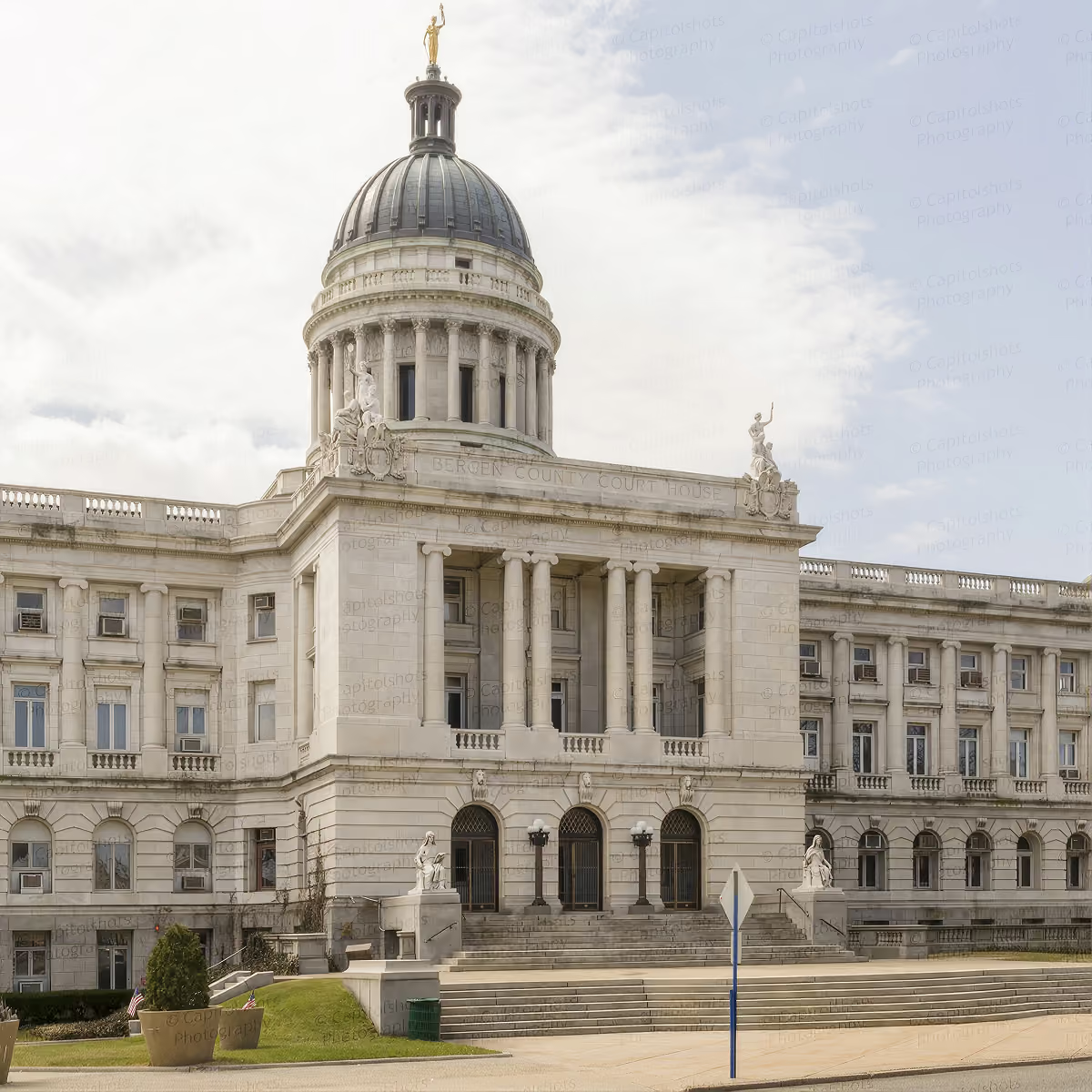
Civil suits arising from Bergen County incidents are filed with the Civil Division at 10 Main Street in Hackensack.
Hurt in New Jersey? Let's Talk.
James Vasquez gives injured people across New Jersey a free, no obligation case review. Tell us what happened and we'll walk you through your options and what your claim may be worth.
.png)
Reach us whatever way works for you.
Need to talk to someone right now?

Areas we serve


.jpg)