Dover Rideshare Accident Lawyer Morris County, New Jersey
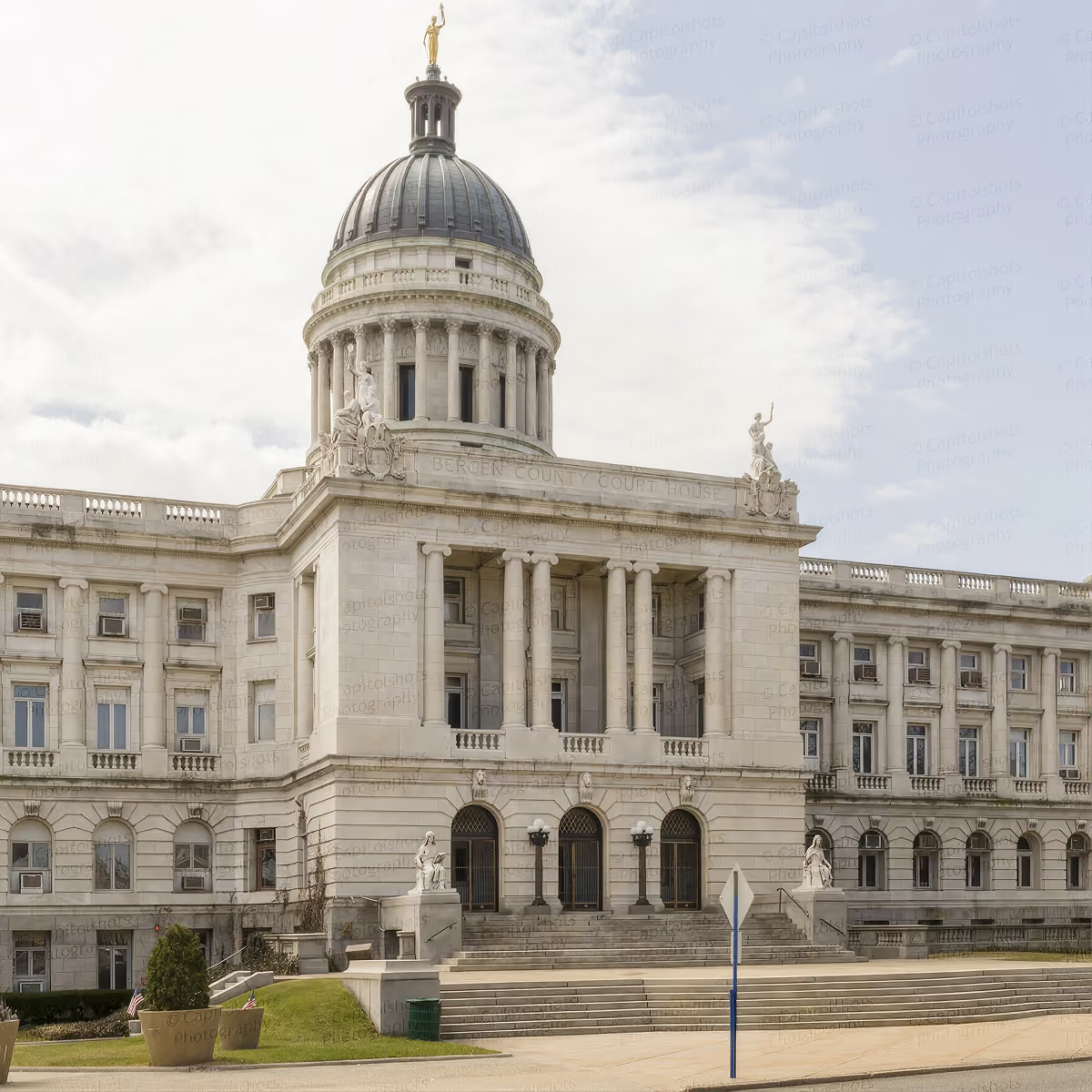
If you were hurt in Hackensack, James Vasquez fights to get you every dollar you are owed. He has represented Bergen County's injured since 2004, and he knows this county seat's I-80, Route 4 and Route 17 corridors, its historic Hackensack River bridges, and the streets around Main Street and Hackensack University Medical Center.
.avif)
New Jersey does not simply accept the label
.avif)
.svg)
Drivers injured while working are told the same thing everywhere. You are a contractor, there is no workers compensation, and whatever the platform provides is what you get. New Jersey's position on that question is considerably less settled than the app suggests.
New Jersey law presumes a worker is an employee, and departing from that requires satisfying the ABC test, all three prongs of it. The state has applied that framework to rideshare companies with real consequences. Uber and its subsidiary were initially assessed in the region of six hundred and fifty million dollars in past due contributions, penalties and interest, and paid one hundred million in 2022 covering roughly three hundred thousand drivers over a five year period. Lyft paid over nineteen million in 2025. Both companies continue to maintain that their drivers are independent contractors. In May 2026 the state adopted rules addressing worker classification, which commentators expect to push rideshare drivers toward employee status. It is worth being precise about what happened. The proposed version of those rules contained examples stating outright that drivers for ride hailing services would fail one or more prongs of the test. Those examples were not present in the rules as adopted. The framework was strengthened and the explicit conclusion about drivers was removed. So the honest position is this. The presumption favours employment, the state has taken an aggressive line and recovered substantial sums, and the question of whether an individual driver is an employee for workers compensation purposes has not been thoroughly tested in the New Jersey courts. That makes it worth raising properly rather than accepting the label on the app. James Vasquez has handled New Jersey injury claims since 2004, and the firm works in English and Spanish.
Rideshare claims we handle in Morris County
Drivers, passengers and the people they collide with.

The three prongs and where the argument sits
A worker is a contractor only where all three are satisfied. Failing any one means employee status.
Prong B
Whether the service is outside the usual course of the business, or performed outside all the places of business of the enterprise.
The argument: this is the pressure point. Whether transporting riders is outside the usual course of a ride hailing company's business is a difficult proposition to sustain.

The presumption
New Jersey compensation law presumes a worker is an employee, which places the burden on the party asserting otherwise.
The argument: it means a driver does not have to establish employment from nothing. The company has to displace the presumption.
The 2026 rules
Rules adopted in May 2026 gave the test more force in the administrative code, without the proposed examples about ride hailing drivers.
The argument: the framework is stronger and the explicit conclusion about drivers was removed, so the question remains one to litigate rather than to assume.

Prong A
Whether the worker is free from control or direction over the performance of the service, both under the contract and in fact.
The argument: companies point to drivers choosing their own hours. Drivers point to fares, routes, deactivation and rating systems set entirely by the platform.
Prong C
Whether the worker is customarily engaged in an independently established trade, occupation, profession or business.
The argument: a driver with their own established transport business is differently placed from someone who drives only when an app tells them to.
What the state has recovered
The assessments against rideshare companies concerned unemployment, disability and family leave contributions rather than workers compensation directly.
The argument: important to be precise about. It is powerful context and it is not a determination that any individual driver is covered by compensation.
None of this is settled in the courts. What it establishes is that the question is genuinely open, which is more than most injured drivers are told.
Six things to understand about your position
This area is developing and the position should be confirmed as it stands when you read this.
You start as an employee
New Jersey compensation law presumes a worker is an employee. Contractor status requires satisfying all three prongs of the ABC test, and failing any one means employee.
The state has pursued this hard
Uber paid one hundred million dollars in 2022 following an assessment initially in the region of six hundred and fifty million. Lyft paid over nineteen million in 2025.
Those were tax cases
They concerned unemployment, disability and family leave contributions rather than workers compensation entitlement for an individual injured driver.
Strengthened in 2026
New Jersey adopted classification rules in May 2026, giving the test more force, though without the proposed examples stating that ride hailing drivers would fail it.
Untested in the courts
Rideshare companies have generally prevailed in classification litigation, and the question has not been thoroughly tested in New Jersey courts.
Employee status cuts both ways
Compensation would provide benefits without proving fault, and it would generally bar suing the company in tort. That is worth understanding before pursuing it.
If you were injured driving, do not accept the contractor label as the end of the analysis. Whether it holds for you is worth assessing on your facts. For how rideshare claims work statewide, see the rideshare accident practice area page.
Three honest points about pursuing this
The argument is available and it is not a shortcut, and both of those matter.

It is not a substitute for the other routes
Whatever happens on classification, the ordinary claims still exist and are usually faster. A claim against whoever caused the collision. Platform coverage responding according to the app period. Any occupational accident cover the company provides. Uninsured motorist coverage on your own policy. Those should be pursued in parallel rather than after a classification argument resolves, because they have their own deadlines.
Employee status is not automatically better
Workers compensation provides medical treatment and partial wage replacement without proving fault, which matters enormously to someone with no income. It also generally bars suing the employer in tort, which removes pain and suffering from the equation as against that party. For a driver with a serious injury caused by the platform's own conduct, that trade is worth thinking about rather than assuming.
The honest answer is that it depends
The presumption favours employment, the state's enforcement record is substantial, and the courts have not thoroughly tested the question. Anybody telling you confidently that you are covered, or that you certainly are not, is overstating what is known. What is worth doing is raising it properly and letting it be assessed on your actual working arrangements.
Three rules about driver status
Developing law. Verify the current position before relying on it.
Employment is the presumption
New Jersey presumes a worker is an employee. Contractor status requires all three prongs: freedom from control over the performance of the service, service outside the usual course of the business or performed outside its places of business, and the worker being customarily engaged in an independently established trade. Failing any one prong means employee status.
Substantial sums recovered
Uber and its subsidiary paid one hundred million dollars in 2022 following an assessment initially in the region of six hundred and fifty million, covering roughly three hundred thousand drivers over five years. Lyft paid over nineteen million in 2025. Both concerned unemployment, disability and family leave contributions rather than workers compensation entitlement.
Employee status limits tort claims
Where an employment relationship is established, workers compensation generally provides benefits without proof of fault and bars suing that employer in tort. It is a genuine trade rather than a pure gain, and it should be weighed rather than assumed to be the better outcome.
Coverage tiers by app period, how medical benefits reach an injured person, and the two year filing deadline are covered on the rideshare practice area page and the Dover personal injury page.
What to gather if you drive
Your working arrangements are the evidence, and only you can assemble them.
Export your full platform history
Trips, earnings, hours and any periods of deactivation. It establishes how much you drove, when, and how much the platform controlled it.
Keep every communication from the platform
Instructions, warnings, rating notifications and deactivation notices. These bear directly on the control question under the first prong.
Record whether you drove for anyone else
Whether you ran your own transport business or drove only when an app assigned work goes to the third prong.
Pursue the ordinary routes at the same time
The claim against whoever caused the crash, platform coverage, occupational accident cover and your own uninsured motorist coverage all have their own deadlines.
Establish your actual earnings
Platform statements and bank deposits. Where the vehicle is your income, lost earnings need documenting rather than estimating.

.avif)

James Vasquez
Before James Vasquez ever represented an injured person, he sat on the other side of the table. As a former prosecutor and insurance-defense attorney, he spent years learning exactly how these cases are won and lost.
Now he uses it for you. When adjusters and opposing counsel face James, they're facing someone who has read their playbook, argued in their courtrooms, and knows precisely where their arguments break.
Based in Clifton and serving Passaic, Morris, and Essex Counties, his firm gives every client James's personal attention, backed by a team that knows your file cold.
Answers, before you even call.
Anything else you’d like to know? Get in touch with our sales team and we’d be happy to discuss your questions.


Hear Our Clients’ Stories

James Vasquez was the first name everyone recommended. People told me he would make sure I was taken care of, and they were right. The team was friendly, professional, down to earth, and experienced. They handled everything, and all I had to do was listen, follow their guidance, and focus on my recovery. One of the best parts of the experience was working with the paralegal, John Velazquez. Whenever I had questions, he would stop what he was doing, sit down with me, and explain everything in detail. I never felt rushed, and I always felt that my concerns were fully answered. He helped me understand every step of the legal process, and I truly felt like I had a friend inside the firm."
Kraig Moultrie


Hear Our Clients’ Stories
After the accident at work, my health and my ability to work changed dramatically. I faced many challenges because I could no longer do the same things I used to do. Before receiving help, I was afraid because my health wasn't improving, and I didn't know what to do. The insurance company made things difficult, asking me questions I didn't know how to answer, and I felt lost and overwhelmed. Then I found this team, and from the very first conversation they gave me confidence and explained everything clearly. They guided me through the entire treatment process, helped me access the medical care I needed, and supported me every step of the way."
Martina Contreras

What it's actually like to work with us
We'll skip the sales pitch. This is what it's actually like to have James in your corner; straight from the people who've been there.

"Staff is very Friendly. They keep you informed on a regular basis. The Attorneys are the best. Would recommend this Law firm to anyone."


"James Vasquez is one of the best Lawyers. He knows what he's doing at all times, very Professional along with his staffs that entire office has very good attitude. He keeps you updated and gives good advise he did very good with my case and I highly recommend him. He deserves more than five stars!"
"James Vasquez and his team took care of my case like if it was their own. I was able to take care of my car accident case, and even during this pandemic. I never felt pressured, and they were definitely patient with my case."
"Throughout this process, James and I kept in touch via email, and he offered his guidance every step of the way."
"I would highly recommend anyone to hire him!"
"Mr. Vasquez was able to recover a good settlement for me and he recommended me to great medical professionals to help with my back and neck injuries."
James Vasquez was the first name everyone recommended. People told me he would make sure I was taken care of, and they were right. The team was friendly, professional, down to earth, and experienced. They handled everything, and all I had to do was listen, follow their guidance, and focus on my recovery. One of the best parts of the experience was working with the paralegal, John Velazquez. Whenever I had questions, he would stop what he was doing, sit down with me, and explain everything in detail. I never felt rushed, and I always felt that my concerns were fully answered. He helped me understand every step of the legal process, and I truly felt like I had a friend inside the firm."
After the accident at work, my health and my ability to work changed dramatically. I faced many challenges because I could no longer do the same things I used to do. Before receiving help, I was afraid because my health wasn't improving, and I didn't know what to do. The insurance company made things difficult, asking me questions I didn't know how to answer, and I felt lost and overwhelmed. Then I found this team, and from the very first conversation they gave me confidence and explained everything clearly. They guided me through the entire treatment process, helped me access the medical care I needed, and supported me every step of the way."
"Staff is very Friendly. They keep you informed on a regular basis. The Attorneys are the best. Would recommend this Law firm to anyone."
"James Vasquez is one of the best Lawyers. He knows what he's doing at all times, very Professional along with his staffs that entire office has very good attitude. He keeps you updated and gives good advise he did very good with my case and I highly recommend him. He deserves more than five stars!"
"James Vasquez and his team took care of my case like if it was their own. I was able to take care of my car accident case, and even during this pandemic. I never felt pressured, and they were definitely patient with my case."
"Throughout this process, James and I kept in touch via email, and he offered his guidance every step of the way."
"I would highly recommend anyone to hire him!"
"Mr. Vasquez was able to recover a good settlement for me and he recommended me to great medical professionals to help with my back and neck injuries."
James Vasquez was the first name everyone recommended. People told me he would make sure I was taken care of, and they were right. The team was friendly, professional, down to earth, and experienced. They handled everything, and all I had to do was listen, follow their guidance, and focus on my recovery. One of the best parts of the experience was working with the paralegal, John Velazquez. Whenever I had questions, he would stop what he was doing, sit down with me, and explain everything in detail. I never felt rushed, and I always felt that my concerns were fully answered. He helped me understand every step of the legal process, and I truly felt like I had a friend inside the firm."
After the accident at work, my health and my ability to work changed dramatically. I faced many challenges because I could no longer do the same things I used to do. Before receiving help, I was afraid because my health wasn't improving, and I didn't know what to do. The insurance company made things difficult, asking me questions I didn't know how to answer, and I felt lost and overwhelmed. Then I found this team, and from the very first conversation they gave me confidence and explained everything clearly. They guided me through the entire treatment process, helped me access the medical care I needed, and supported me every step of the way."
Some of it is yours and some of it belongs to the platform.
Trip history, earnings statements, hours and any deactivation records. Export it rather than relying on continued access.
Administers the classification framework and has pursued rideshare companies over it. Publishes guidance on worker classification.
What liability and occupational accident cover it provides by app period, which applies whatever the classification answer turns out to be.
The declarations page establishes whether you carry any endorsement covering rideshare use, and your uninsured motorist protection.
Hurt in New Jersey? Let's Talk.
James Vasquez gives injured people across New Jersey a free, no obligation case review. Tell us what happened and we'll walk you through your options and what your claim may be worth.
.png)
Reach us whatever way works for you.
Need to talk to someone right now?

Areas we serve



.jpg)