Dover Catastrophic Injury Lawyer Morris County, New Jersey
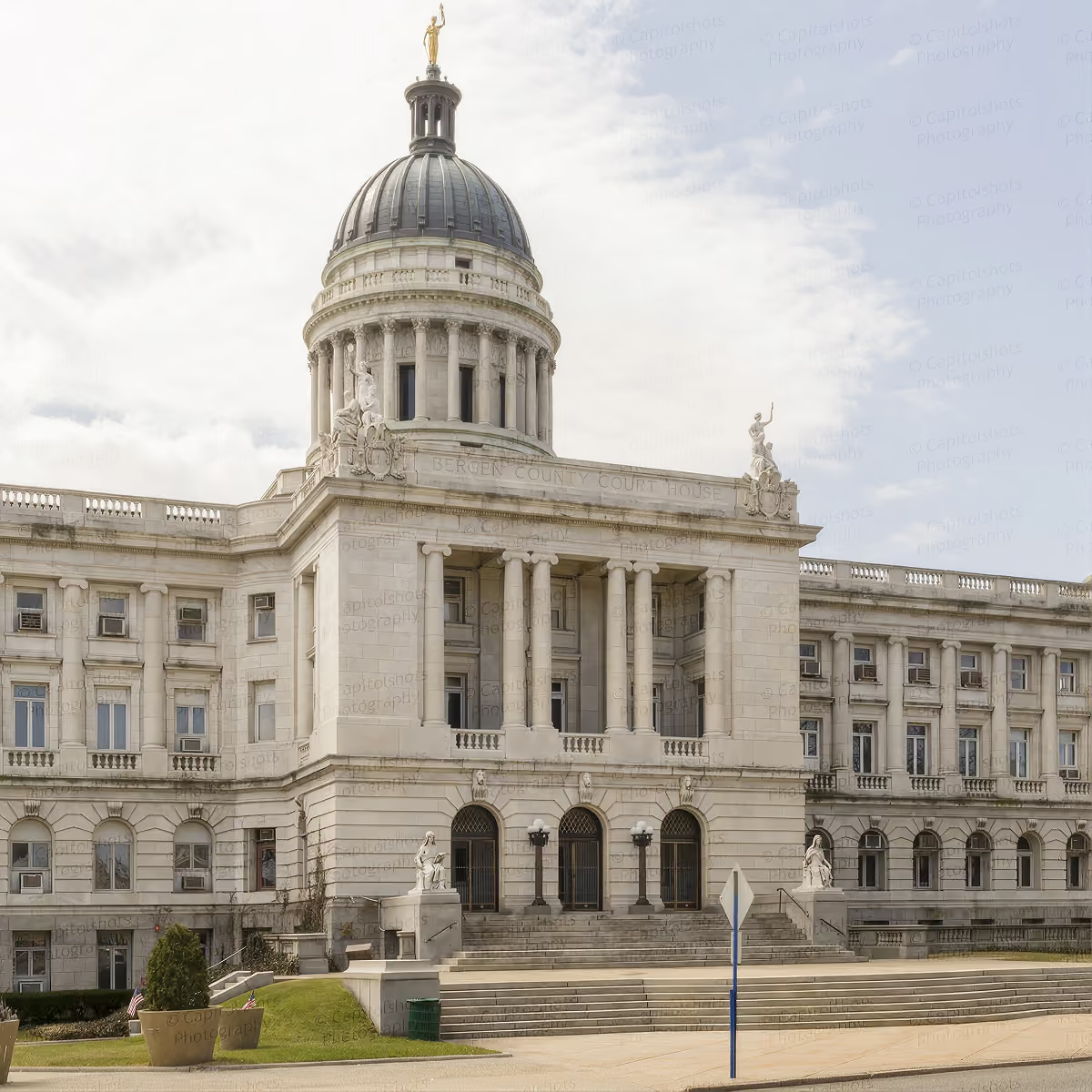
If you were hurt in Hackensack, James Vasquez fights to get you every dollar you are owed. He has represented Bergen County's injured since 2004, and he knows this county seat's I-80, Route 4 and Route 17 corridors, its historic Hackensack River bridges, and the streets around Main Street and Hackensack University Medical Center.
.avif)
Theoretical work and available work are not the same thing
.avif)
.svg)
In a catastrophic case where somebody can still do something, the largest element of the claim is usually the gap between what they earned before and what they can earn now. That gap is contested with vocational evidence, and the methodology matters enormously.
A vocational expert works through a defined sequence. Records review covering medical notes, any functional capacity evaluation, physician imposed work restrictions and the employment history including tax returns and job descriptions. An interview about work history, training and how the injury affects daily working activity. Testing where it applies, covering aptitude, achievement and work tolerances. Then a transferable skills analysis, using occupational databases, identifying which skills from the previous occupation carry across and which do not. That produces a list of occupational categories. The defence will stop there, because the list looks like opportunity. The next step is a labour market survey establishing whether those jobs actually exist within a reasonable commuting distance, and after that the question that matters most, which is placeability. Would an employer in this market actually hire this person. The difference is not academic. A fifty two year old former foreman with a spinal injury and no experience outside construction faces a hiring reality that a thirty one year old office worker with a shoulder injury does not, even where a database says both could perform the same role. James Vasquez has handled New Jersey injury claims since 2004.
Catastrophic injuries we handle in Morris County
The earning capacity question is largest where someone retains some ability to work.

How lost earning capacity is actually established
Each stage is a document, and the defence contests them in this order.
Functional capacity evaluation
Structured testing of lifting, standing, sitting, reaching and endurance, producing measured tolerances rather than descriptions.
Where it is attacked: effort and consistency. A properly conducted evaluation includes validity measures, which is why engaging honestly with it matters.

Transferable skills analysis
Using occupational databases to identify which skills from the previous occupation transfer to other roles and which do not.
Where it is attacked: this is where the defence produces its list. The analysis is only as good as the restrictions and the work history fed into it.
Placeability
Whether an employer in this market would actually hire this person, given age, restrictions, work history and any gap in relevant experience.
Where it is attacked: it is frequently ignored entirely, because a theoretical list is more useful to the defence than an honest hiring analysis.

Records review
Medical notes, any functional capacity evaluation, physician imposed restrictions, and the employment record including tax returns, pay records and job descriptions.
Where it is attacked: the restrictions themselves. If the defence can narrow what a physician actually imposed, everything downstream shifts.
The vocational interview
Work history, education, training and the person's own account of how the injury affects a working day.
Where it is attacked: inconsistency with the medical record or with social media, which is why accuracy rather than emphasis is the right approach.
Labour market survey
Establishing whether the identified roles actually exist within a reasonable commuting distance, commonly assessed around a defined radius.
Where it is attacked: the geography. A job that exists two hours away is not realistically available to someone who can no longer drive for long periods.
The economist comes last, converting the difference between pre and post injury capacity into a figure. Everything above determines what that figure is.
Six things that separate theoretical work from real work
This is where catastrophic earning capacity claims are won and lost.
Functional capacity evaluation
Structured testing of lifting, standing, sitting, reaching and endurance, producing measured tolerances rather than descriptions.
The vocational interview
Work history, education, training and the person's own account of how the injury affects a working day.
Transferable skills analysis
Using occupational databases to identify which skills from the previous occupation transfer to other roles and which do not.
Labour market survey
Establishing whether the identified roles actually exist within a reasonable commuting distance, commonly assessed around a defined radius.
Placeability
Whether an employer in this market would actually hire this person, given age, restrictions, work history and any gap in relevant experience.
Records review
Medical notes, any functional capacity evaluation, physician imposed restrictions, and the employment record including tax returns, pay records and job descriptions.
If you have been given a list of jobs you could supposedly do, that list is a starting point for an argument rather than an assessment of your position. For how these claims work statewide, see the catastrophic injury practice area page.
Why methodology decides which expert a jury believes
Both sides produce a vocational expert. What separates them is whether the work behind the opinion was actually done.

Restrictions have to come from somewhere
A vocational opinion is built on physician imposed restrictions and, where available, functional capacity testing. An expert who assumes restrictions, or who works from a defence physician's report without addressing the treating record, has built an analysis on a foundation that can be dismantled. The strongest opinions identify precisely which document each restriction comes from.
A labour market survey is empirical or it is not
Identifying occupational categories from a database is desk work. Establishing that specific positions exist within a reasonable commuting distance, and at what wages, requires actual research into the relevant market. Where a defence expert has produced categories without surveying the market they exist in, that gap is worth exposing rather than arguing around.
Placeability is the honest part
The question of whether an employer would actually hire this person is uncomfortable for both sides. It requires acknowledging age, gaps, language and everything else that affects real hiring. An expert willing to address it produces an opinion a jury recognises as describing the world they live in, which is worth more than a defensible list of job codes.
Three rules about earning capacity
These determine what has to be proved and by what means.
The measure is what you could earn
New Jersey compensates the diminished capacity to earn rather than only wages actually lost. Someone still working, or working reduced hours, may have a substantial claim where their ability to earn across a remaining working life has been reduced, including through lost promotion prospects and restricted options.
Future loss must be established
Damages for future losses require evidence that they are reasonably probable rather than merely possible. In earning capacity that means a documented chain from medical restrictions through vocational analysis to an economic projection, rather than an assertion about what someone can no longer do.
An opinion needs a foundation
New Jersey courts examine whether an expert opinion rests on identifiable facts and accepted methodology rather than on the expert's say so. In vocational evidence that scrutiny falls on where restrictions came from, how occupations were identified, and whether the labour market was actually surveyed.
Lifetime care projection, guardianship where capacity is affected, reimbursement obligations and how fault is allocated among defendants are covered on the catastrophic injury practice area page and the Dover personal injury page.
What helps the earning capacity case
Most of it is documentation only you can provide.
Gather the full employment history
Tax returns, pay records, job descriptions, performance reviews and any training or certification. This establishes what you were actually earning and doing.
Keep every set of work restrictions
Each physician imposed limitation, with dates. These are the foundation of the entire vocational analysis and they change over time.
Record what a working day now costs you
Not just what you can do, but what it takes out of you and how long you can sustain it. Endurance is what separates capability from employability.
Document any attempt to work
Applications, interviews, trial returns that did not last. A genuine attempt that failed is evidence rather than a mark against you.
Engage honestly with testing
Functional capacity evaluations include validity measures. A clean profile makes your results far harder for the other side to dismiss.

.avif)

James Vasquez
Before James Vasquez ever represented an injured person, he sat on the other side of the table. As a former prosecutor and insurance-defense attorney, he spent years learning exactly how these cases are won and lost.
Now he uses it for you. When adjusters and opposing counsel face James, they're facing someone who has read their playbook, argued in their courtrooms, and knows precisely where their arguments break.
Based in Clifton and serving Passaic, Morris, and Essex Counties, his firm gives every client James's personal attention, backed by a team that knows your file cold.
Answers, before you even call.
Anything else you’d like to know? Get in touch with our sales team and we’d be happy to discuss your questions.


Hear Our Clients’ Stories

James Vasquez was the first name everyone recommended. People told me he would make sure I was taken care of, and they were right. The team was friendly, professional, down to earth, and experienced. They handled everything, and all I had to do was listen, follow their guidance, and focus on my recovery. One of the best parts of the experience was working with the paralegal, John Velazquez. Whenever I had questions, he would stop what he was doing, sit down with me, and explain everything in detail. I never felt rushed, and I always felt that my concerns were fully answered. He helped me understand every step of the legal process, and I truly felt like I had a friend inside the firm."
Kraig Moultrie


Hear Our Clients’ Stories
After the accident at work, my health and my ability to work changed dramatically. I faced many challenges because I could no longer do the same things I used to do. Before receiving help, I was afraid because my health wasn't improving, and I didn't know what to do. The insurance company made things difficult, asking me questions I didn't know how to answer, and I felt lost and overwhelmed. Then I found this team, and from the very first conversation they gave me confidence and explained everything clearly. They guided me through the entire treatment process, helped me access the medical care I needed, and supported me every step of the way."
Martina Contreras

What it's actually like to work with us
We'll skip the sales pitch. This is what it's actually like to have James in your corner; straight from the people who've been there.

"Staff is very Friendly. They keep you informed on a regular basis. The Attorneys are the best. Would recommend this Law firm to anyone."


"James Vasquez is one of the best Lawyers. He knows what he's doing at all times, very Professional along with his staffs that entire office has very good attitude. He keeps you updated and gives good advise he did very good with my case and I highly recommend him. He deserves more than five stars!"
"James Vasquez and his team took care of my case like if it was their own. I was able to take care of my car accident case, and even during this pandemic. I never felt pressured, and they were definitely patient with my case."
"Throughout this process, James and I kept in touch via email, and he offered his guidance every step of the way."
"I would highly recommend anyone to hire him!"
"Mr. Vasquez was able to recover a good settlement for me and he recommended me to great medical professionals to help with my back and neck injuries."
James Vasquez was the first name everyone recommended. People told me he would make sure I was taken care of, and they were right. The team was friendly, professional, down to earth, and experienced. They handled everything, and all I had to do was listen, follow their guidance, and focus on my recovery. One of the best parts of the experience was working with the paralegal, John Velazquez. Whenever I had questions, he would stop what he was doing, sit down with me, and explain everything in detail. I never felt rushed, and I always felt that my concerns were fully answered. He helped me understand every step of the legal process, and I truly felt like I had a friend inside the firm."
After the accident at work, my health and my ability to work changed dramatically. I faced many challenges because I could no longer do the same things I used to do. Before receiving help, I was afraid because my health wasn't improving, and I didn't know what to do. The insurance company made things difficult, asking me questions I didn't know how to answer, and I felt lost and overwhelmed. Then I found this team, and from the very first conversation they gave me confidence and explained everything clearly. They guided me through the entire treatment process, helped me access the medical care I needed, and supported me every step of the way."
"Staff is very Friendly. They keep you informed on a regular basis. The Attorneys are the best. Would recommend this Law firm to anyone."
"James Vasquez is one of the best Lawyers. He knows what he's doing at all times, very Professional along with his staffs that entire office has very good attitude. He keeps you updated and gives good advise he did very good with my case and I highly recommend him. He deserves more than five stars!"
"James Vasquez and his team took care of my case like if it was their own. I was able to take care of my car accident case, and even during this pandemic. I never felt pressured, and they were definitely patient with my case."
"Throughout this process, James and I kept in touch via email, and he offered his guidance every step of the way."
"I would highly recommend anyone to hire him!"
"Mr. Vasquez was able to recover a good settlement for me and he recommended me to great medical professionals to help with my back and neck injuries."
James Vasquez was the first name everyone recommended. People told me he would make sure I was taken care of, and they were right. The team was friendly, professional, down to earth, and experienced. They handled everything, and all I had to do was listen, follow their guidance, and focus on my recovery. One of the best parts of the experience was working with the paralegal, John Velazquez. Whenever I had questions, he would stop what he was doing, sit down with me, and explain everything in detail. I never felt rushed, and I always felt that my concerns were fully answered. He helped me understand every step of the legal process, and I truly felt like I had a friend inside the firm."
After the accident at work, my health and my ability to work changed dramatically. I faced many challenges because I could no longer do the same things I used to do. Before receiving help, I was afraid because my health wasn't improving, and I didn't know what to do. The insurance company made things difficult, asking me questions I didn't know how to answer, and I felt lost and overwhelmed. Then I found this team, and from the very first conversation they gave me confidence and explained everything clearly. They guided me through the entire treatment process, helped me access the medical care I needed, and supported me every step of the way."
Several specialists, each addressing a different link in the chain.
Impose the work restrictions everything else is built on. Their documentation matters more than any expert retained later.
Produce measured tolerances for lifting, standing, sitting and endurance, including validity measures assessing consistency of effort.
Conduct transferable skills analysis and labour market research, and address whether identified work is realistically available to this person.
Convert the difference between pre and post injury earning capacity into a projected figure across a working life.
Hurt in New Jersey? Let's Talk.
James Vasquez gives injured people across New Jersey a free, no obligation case review. Tell us what happened and we'll walk you through your options and what your claim may be worth.
.png)
Reach us whatever way works for you.
Need to talk to someone right now?

Areas we serve


.jpg)